Financing products

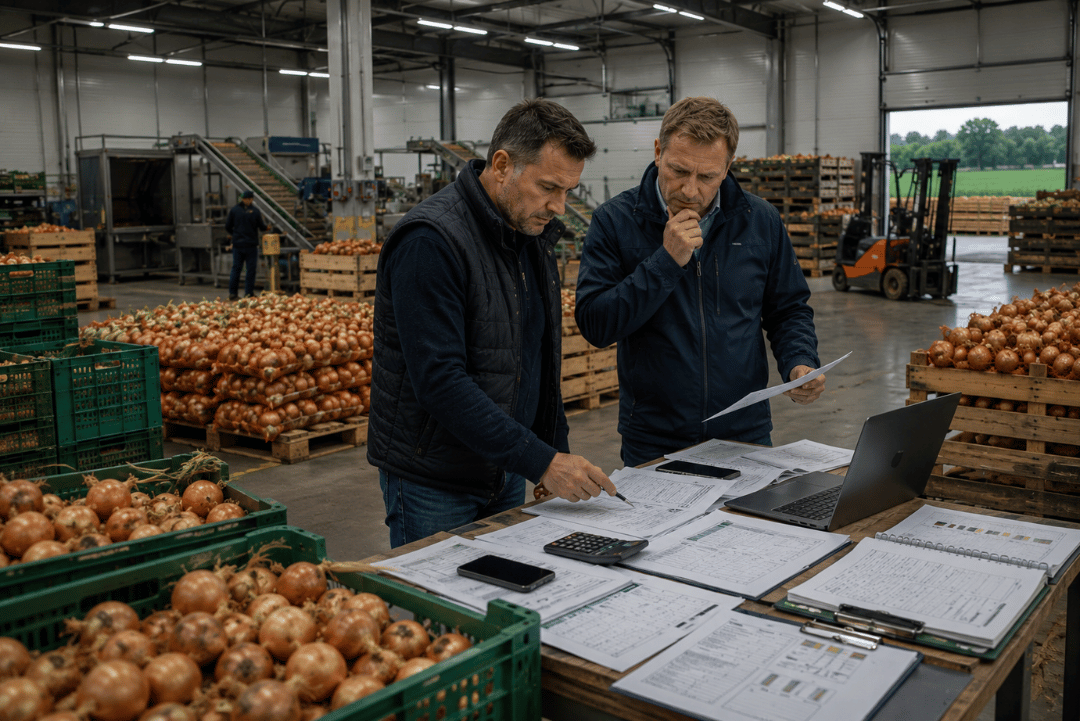
At first glance, 350 or 400 tonnes of onions sounds like a success. The field produced a strong crop, the product is of good quality and months of work delivered a visible result. The problem begins when a buyer offers a price that does not even cover the cultivation cost, while harvesting, transport and selling the crop would require further spending.
An onion grower in Radostów in Lower Silesia faced exactly this situation. Around 350-400 tonnes of white onions remained across eight hectares. According to the farmer, cultivating one hectare cost approximately PLN 16,000, while private buyers offered PLN 0.18 per kilogram. Instead of ploughing the crop back into the field, the farmer invited local residents to pick their own onions and offered them at PLN 1 per kilogram. The story was reported by Interia and the local news service eLuban.pl, among others.
This is not only a story about onions. It illustrates a risk that appears whenever production costs are incurred before the final selling price is known. It affects vegetable and fruit growers, livestock farmers and orchard owners, as well as many manufacturing and trading businesses that operate seasonally.
More product does not guarantee more profit. If rising supply pushes the price below the unit cost, a strong production result can turn into a serious financial problem.
What does the bumper harvest paradox mean?
The bumper harvest paradox is not a formal term defining one specific market condition. In everyday and economic language, it describes a situation in which high production creates oversupply, falling prices and weaker profitability. The crop can be excellent in terms of volume while the financial result is very poor.
The mechanism most often looks like this:
- Many producers harvest large quantities of the same product.
- More goods reach the market within a short period than buyers are willing to purchase at the previous price.
- The product has a limited shelf life or requires costly storage.
- Buyers can choose from many offers and push prices down.
- The producer must decide whether to sell for less, pay for storage, find another sales channel or leave part of the crop in the field.
The problem is therefore not the volume of the harvest itself. It is the financial result created by high supply, limited demand, time pressure and costs that have already been incurred.
The cause is not always a bumper crop in one country. Prices can also be affected by inventories from the previous season, imports, changing customer preferences, product quality, export capacity and the decisions of the largest buyers. In the case of the onions from Radostów, the farmer also pointed to competition from inexpensive Dutch produce.
It is therefore more accurate to talk about oversupply pressure and low farmgate prices than to treat one story as automatic proof of a nationwide bumper harvest crisis in a particular crop.
Four hundred tonnes of onions that are not worth selling
The Radostów case shows the scale of the problem in concrete numbers. According to the information given to the media, the farmer planted eight hectares, harvested approximately 350-400 tonnes of onions and estimated the cultivation cost at around PLN 16,000 per hectare.
Using these figures, the reported cultivation cost alone comes to approximately PLN 128,000. Selling the entire crop at PLN 0.18 per kilogram would generate between PLN 63,000 and PLN 72,000 in revenue. That leaves a shortfall of approximately PLN 56,000-65,000 before adding any harvesting, grading, transport or selling costs.
This is a simplified calculation, but its conclusion is clear: selling a larger quantity does not help if the unit price is below the full cost of producing and selling it.
The cost reported by one farmer is not a market average. Onion production costs can include seed, fertiliser, crop protection, irrigation, fuel, labour, equipment depreciation, land rent, harvesting, drying, grading and storage. Industry calculations show a wide range of expenditure depending on the technology and intensity of cultivation. Agro Profil also notes that profitability depends on marketable quality and storage potential, not simply the number of tonnes harvested.
Would selling at PLN 1 per kilogram reverse the result?
If the farmer sold the entire 350-400 tonnes through pick-your-own sales at PLN 1 per kilogram, revenue would theoretically reach PLN 350,000-400,000. This does not mean that such a scenario can be achieved in practice.
Selling hundreds of tonnes directly to consumers requires an enormous number of customers, time, traffic management, weighing, payment handling, communication and on-site support. Some of the crop may remain unsold or lose quality. A retail price is therefore not automatically a price at which the entire wholesale volume can be sold.
Pick-your-own sales can reduce the loss. They do not change the capacity of the local market or guarantee that the full volume will be sold.
Why can a larger harvest produce less revenue?
Revenue is the product of the quantity sold and the unit price:
Revenue = quantity sold x unit price
If quantity rises but price falls even faster, total revenue declines. A farm can harvest more tonnes than in the previous year and still receive less money.
Suppose that in one season a farm sells 100 tonnes of a product at PLN 1 per kilogram. Revenue is PLN 100,000. In the following season, the crop grows by 20% to 120 tonnes, but the price falls to PLN 0.50. Revenue is now PLN 60,000. Production increased, but revenue declined by 40%.
Revenue still does not reveal the final result. The full production, harvesting and selling cost must be deducted. If the farm spent more on fertiliser, energy, labour or irrigation, a strong crop may merely reduce the loss rather than produce a profit.
The second problem concerns produce that cannot be sold. A crop that has been harvested but has no buyer does not create revenue. It can, however, generate further costs and quality losses.
The retail price and the price received by the producer
Comparing a retail price with a farmgate offer understandably causes frustration. A farmer may be offered only a few dozen groszy per kilogram while the consumer pays several zloty. This does not mean that the entire difference becomes the profit of a single intermediary.
Between the field and the supermarket shelf, the following may be required:
- harvesting and transport from the farm
- cleaning, drying and grading
- rejection of produce that does not meet quality requirements
- packaging and labelling
- storage and shrinkage
- transport to a distribution centre and store
- wholesaler, distributor and retailer margins
- energy, labour, premises and logistics costs
- taxes and the risk of unsold stock
The producer's economic problem remains real. If the price at the beginning of the chain does not cover production and harvesting costs, the farm cannot fund the next cycle, even if the product retains a high retail price.
Prices should also be compared at the same stage of trade. A price offered for a large quantity of onions still in the field is not directly comparable with the wholesale price of graded and packed onions or with the retail price. Quality, packaging, lot size, timing, responsibility for logistics and the customer group are different.
What can reduce the price of an agricultural product?
The price of an agricultural product is shaped by several factors, some of which are completely outside the control of an individual farm.
High domestic or European supply
When many farms harvest a similar product at the same time, buyers have more choice. If demand remains unchanged, sellers begin competing on price.
An analysis by the BNP Paribas Food & Agro team indicated that the supply of most key vegetables after the 2025 harvest was 5-12% higher, although onions were an exception with a 4% year-on-year decline in supply. The bank forecast that most vegetables could be approximately 10-15% cheaper in the first half of 2026. This shows why the situation of the entire vegetable market should not automatically be applied to every crop. See the BNP Paribas analysis.
Imports and stocks from the previous season
A domestic producer competes with more than farms in the same region. Prices are affected by goods available across the European Union, stocks held by larger producers and the ability to import quickly.
According to Statistics Poland data cited by Top Agrar, Poland imported 50,200 tonnes of onions and shallots between January and the end of April 2026. More than 67% of this volume came from the Netherlands. The average import price for the entire period was PLN 1.11 per kilogram, with substantial differences between countries and months. See the onion import data.
These values are not directly comparable with the PLN 0.18 offer received by the Radostów farmer. They do show, however, that a local price also depends on supply and trading conditions outside the region.
Marketable quality and intended use
Two lots of the same vegetable can receive very different prices. Relevant factors include:
- variety and size grade
- dry matter content
- damage and disease
- suitability for long-term storage
- preparation for sale
- the requirements of a processor or retailer
- delivery date
- lot size and consistency
A high total yield does not necessarily mean a high marketable yield. Some of the crop may be rejected, sold for processing at a lower price or lost during storage.
Time pressure
A product that loses quality quickly gives the seller little time to negotiate. The buyer knows that the producer cannot wait indefinitely. If the farm has no storage facility, alternative market or collection agreement, its negotiating position weakens with every passing day.
Buyer concentration
A large volume is difficult to sell to individual consumers. The farm needs a collection point, processor, retail chain, wholesaler or group of buyers capable of taking hundreds of tonnes. The fewer realistic sales channels there are, the more the farm depends on the terms offered by a small group of purchasers.
Farm profitability and liquidity are two different problems
Profitability answers whether selling the product covers all costs and leaves a surplus. Liquidity answers a different question: does the farm have cash exactly when it must pay for seed, fertiliser, fuel, labour, energy, instalments and taxes?
In agriculture, these two areas can diverge particularly easily. Spending continues for many months, while the main inflow may arrive only after harvest. Even profitable production can create a temporary cash gap.
The cycle may look like this:
- The farm buys inputs and prepares the field.
- Throughout the season it funds fertilisation, crop protection, water, fuel and labour.
- It incurs the cost of harvesting and preparing the produce.
- It sells immediately or stores the product while waiting for a better price.
- It receives payment immediately or after the contractual payment period.
Money remains committed from the first expense until payment is received. The longer the cycle and the larger the cultivated area, the more working capital the farm needs.
It is important to identify which problem is actually present:
- A temporary liquidity gap occurs when the sale is profitable and there is a credible buyer, but cash will return later than expenses fall due.
- A profitability problem occurs when the achievable selling price does not cover the full cost of production, preparation and delivery.
- A route-to-market problem occurs when there is no confirmed buyer or the market can absorb only part of the volume.
Financing can sometimes close the first gap. It does not create a margin or a buyer. If the product is sold at a loss, a new repayment adds future pressure instead of removing the source of the problem.
Do pick-your-own sales solve the oversupply problem?
Pick-your-own sales allow customers to enter a field, orchard or plantation, collect the produce themselves and pay the farmer directly. In recent seasons, the model has become more popular for peppers, potatoes, onions, cabbage, apples and soft fruit, among other products. Rzeczpospolita notes that this method can allow a farmer to obtain a higher price than from a commercial buyer while reducing some harvesting, storage and transport costs.
From the perspective of farm finances, pick-your-own sales can:
- open a direct sales channel quickly
- reduce manual harvesting costs
- reduce the amount of unsold produce
- shorten the route between producer and customer
- generate cash faster than some wholesale channels
- build local awareness of the farm
They are not a solution for every scale. Hundreds of tonnes require thousands of customers. The farm must provide safe access, rules for moving around the field, weighing, payment handling, availability updates and support during set hours. Weather can limit traffic, while sudden interest can create organisational chaos.
Pick-your-own is therefore an additional sales channel and a way to reduce a loss. It does not replace contracting, wholesale distribution, storage or a planned buyer structure.
How do you calculate a break-even price?
The simplest break-even price is calculated by dividing all costs by the quantity of produce that can realistically be sold:
Break-even price = full production and selling cost / quantity of marketable product
The most common error is dividing the cost by the entire crop harvested from the field. Not every kilogram will have a marketable value. The calculation must account for rejects, harvesting losses, storage shrinkage and the share of produce for which no buyer exists.
How marketable losses change the calculation
Suppose the full production and preparation cost of a lot is PLN 200,000 and the harvest is 500 tonnes. Simple division gives PLN 0.40 per kilogram. If only 400 tonnes meet commercial requirements and find a buyer, the actual threshold rises to PLN 0.50 per kilogram.
If another 40 tonnes are lost during storage, the cost allocated to each kilogram sold rises to approximately PLN 0.56. This is why a storage decision cannot be based only on the hope that the price will rise.
How can a farm prepare for several price scenarios?
The exact post-harvest price cannot be predicted, but the farm can test in advance how it will perform under several scenarios. A simple model should include marketable yield, price, percentage of volume sold, additional costs and the timing of inflows.
The model should answer several questions:
- What price covers full cost at the average yield?
- How does the threshold change if 10%, 20% or 30% of the product has no buyer?
- How much does each month of storage cost?
- What quality losses may occur in storage?
- Will a PLN 0.10 price increase cover energy, financing and losses?
- What share of production has a confirmed sales channel?
- How much cash is required until the first inflow?
- Can the farm survive the difficult scenario without postponing mandatory payments?
Calculating a difficult scenario in advance does not eliminate risk. It does create time to change the cultivated area, crop mix, sales channel, contract terms or required cash buffer.
When can financing help and when can it make matters worse?
Financing cannot increase the farmgate price. It can be a tool for managing timing when the product has real value, there is a realistic route to sale and the problem is that costs arise before the inflow.
It may be justified when the farm or business:
- has a confirmed buyer and payment date
- knows the full cost and sales margin
- needs funds to harvest or deliver a contracted lot
- can store the product and the cautious scenario covers the cost of storage and capital
- is financing a short, specific gap between an expense and an inflow
- has a repayment source that does not depend on the most optimistic price
Financing can make matters worse when:
- the selling price remains below full cost
- there is no credible buyer
- most of the product depends on one unconfirmed sales channel
- repayment requires a price increase that is not supported by evidence
- storage and debt service costs rise faster than the possible price
- another liability is intended to fund a recurring loss across successive seasons
The onion case illustrates this boundary clearly. If financing were used to pay for harvesting and transporting a product sold at a price already below the cultivation cost, it could only increase the loss. The situation would be different if the farm had signed a contract at a profitable price but needed funds to prepare and deliver the goods before receiving payment.
What should you check before taking on financing?
A seasonal business owner should be able to answer not only how much money is needed, but also why it is needed, for how long and which inflow will repay it.
Before making a decision, establish:
- What is the full product cost, not only the input cost?
- How much of the crop is marketable?
- What volume is covered by an agreement or confirmed order?
- Does the quoted price include transport, grading and packaging?
- When exactly will payment be received?
- What does the result look like if the price is 10%, 20% or 30% lower?
- What happens if part of the product has no buyer?
- How much does storage cost, including shrinkage and energy?
- Does the repayment schedule match the seasonal inflow pattern?
- Can the business repay the financing without assuming the best possible scenario?
The full cost of financing, the amount actually received and the early repayment rules should also be compared. We explain this in more detail in our article on how much a non-bank business loan costs.
If financing can be repaid only if the price rises substantially and the entire crop is sold without loss, the assumptions are too fragile. A safe model should also work under a less favourable outcome.
What can every business learn from the bumper harvest paradox?
Agriculture makes the mechanism particularly visible, but the problem does not end at the field. A clothing company can be left with a collection after the season. A furniture manufacturer can increase output before orders decline. A distributor can purchase stock at a price the market later rejects. An e-commerce business can tie up cash in goods that must be discounted.
Each of these cases involves a similar set of risks:
- cost is incurred before revenue
- the final price may be lower than expected
- part of the stock may not find a buyer
- storage extends the cash cycle and creates further costs
- greater scale increases both the potential profit and the potential loss
A business owner should therefore monitor more than production or sales volume. The minimum price, share of contracted volume, inventory turnover, buyer concentration, timing of inflows and full cost of capital matter just as much.
A strong operating result is not about producing the largest possible quantity. It is about selling the right quantity at a price that covers all costs, leaves a margin and protects liquidity until the next cycle.
Summary
The bumper harvest paradox reveals a basic contradiction in agricultural production: the field can produce an excellent crop while the farm still loses money. This happens when rising supply, imports, a limited number of buyers or time pressure push the price below full cost.
The Radostów case is a useful warning against judging a result only by the number of tonnes. Based on the figures reported by the farmer, an offer of PLN 0.18 per kilogram would not cover even the stated cultivation cost, before harvesting and transport are considered.
Before making the next decision, calculate:
- full unit cost
- actual marketable yield
- the break-even price
- the share of production with a confirmed buyer
- the cost and losses associated with storage
- the cash gap until payment
- the result under a scenario more difficult than the plan
Financing can support a profitable cycle and bridge an expense until a predictable inflow arrives. It should not be used to keep adding cash to a product whose price does not cover its costs.