Financing products

October 29, 2026
First- and Second-Ranking Mortgages in Poland - How Does Mortgage Priority Affect Business Financing?
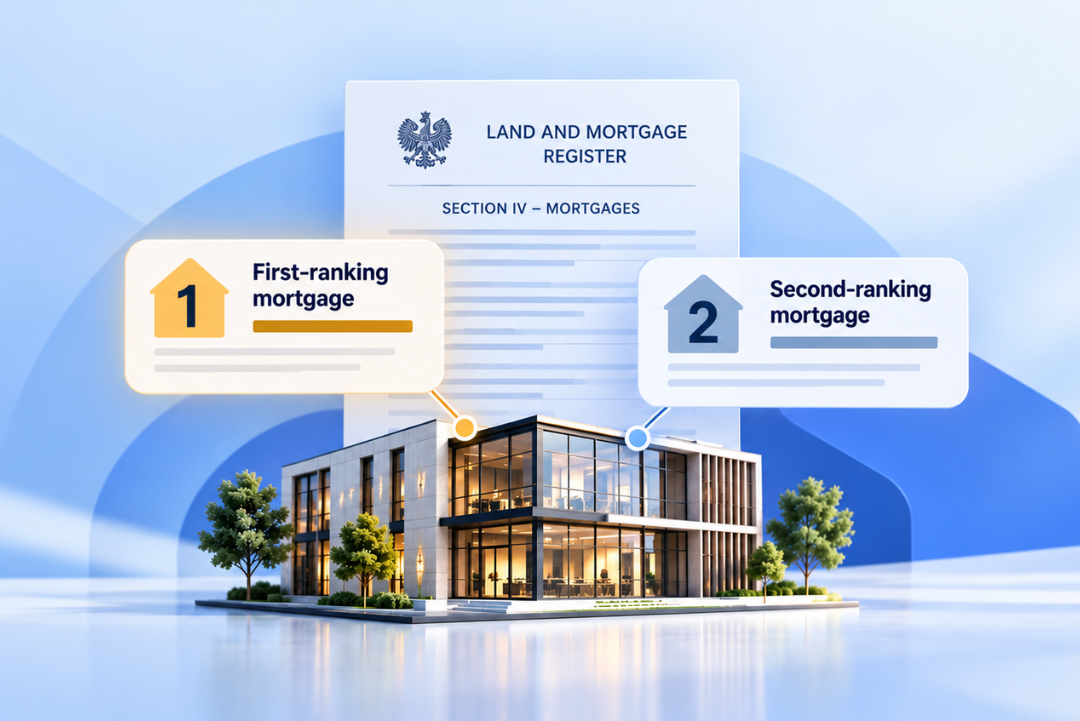
A company owns a property worth PLN 2 million, but its land and mortgage register already contains a mortgage securing an existing bank loan. The business wants to use the same property to obtain additional financing. Is that possible?
The answer depends on more than the property's value and the outstanding debt. The ranking of the mortgages - in other words, the priority of the respective creditors' rights - is also important.
In practice, financing providers refer to first-ranking and second-ranking mortgages. A first-ranking mortgage gives the creditor a more favourable position when proceeds from the property are distributed. A second-ranking mortgage may secure additional financing, but its effectiveness depends partly on how much value remains after creditors with higher priority have been satisfied.
Mortgage priority therefore matters both to the financing provider and to a business owner seeking additional capital without selling the property.
We explain how mortgage priority works in Poland, what to check in the land and mortgage register, and why repaying an earlier loan does not always automatically resolve the ranking of mortgage security interests.
What are first- and second-ranking mortgages?
A mortgage is a limited property right that allows a claim to be secured against real estate or another right that may be mortgaged under Polish law.
Under Article 65 of the Polish Land and Mortgage Registers and Mortgage Act, a mortgage creditor may seek satisfaction of the secured claim from the mortgaged property under the applicable legal rules, regardless of who owns it.
Several mortgages may be established over the same property to secure different claims, including claims held by different financing providers.
In such circumstances, their ranking becomes important.
A first-ranking mortgage is the commonly used term for a mortgage that has priority over other mortgages encumbering the property. In a typical situation, its creditor occupies a more favourable position when seeking satisfaction from the property.
A second-ranking mortgage has lower priority. When proceeds from the property are distributed, the second-ranking creditor may receive payment only from the amount remaining after rights with higher priority have been taken into account, in accordance with applicable law.
This does not mean that a second-ranking mortgage is invalid or cannot secure financing.
It remains a legally recognised security interest. However, its value from the financing provider's perspective may be lower because the same asset already secures an earlier obligation.
For more information about mortgages and other forms of business financing collateral, read our guide to the types of property that can be used as security for a business loan.
What determines mortgage priority in the land and mortgage register?
Mortgage priority does not depend solely on the date the loan agreement was signed or which creditor provided financing first.
The general rule is set out in Article 12 of the Polish Land and Mortgage Registers and Mortgage Act: priority between limited property rights entered in the land and mortgage register is determined by the point from which the entries take legal effect.
Under Article 29 of the same Act, an entry generally takes effect retroactively from the moment the application for that entry was submitted.
This is particularly important because a mortgage may appear in the register only after the court has processed the application, while its legal effects may date back to an earlier point.
Does the registration date or application date determine priority?
In a typical situation, the relevant factor is the moment the application was submitted, from which the subsequent entry takes legal effect, rather than simply the date on which the court completed its review.
Example: An application to register a mortgage for Bank A is submitted on 3 June. An application for Financing Provider B is submitted on 10 June. The court processes both applications later.
If both mortgages are validly registered and no circumstances modify their priority, Bank A's mortgage will have the earlier ranking.
Polish law also provides for equal priority in certain circumstances, including rights entered on the basis of applications submitted simultaneously, as well as special arrangements affecting priority.
Therefore, the order in which mortgages appear on the screen should not be treated as the only relevant legal criterion.
Where can you check mortgage priority?
The main source of information is Section IV of the land and mortgage register (księga wieczysta, or KW), which contains mortgage entries.
If you know the register number, you can review the register through the official Electronic Land and Mortgage Registers service operated by the Polish Ministry of Justice.
In Section IV, pay attention to the creditor, the registered mortgage amount, the claim being secured and any information about changes or pending applications.
It is also worth reviewing Section III, where other rights, claims and restrictions relevant to the property assessment may appear.
However, the existence of an entry does not reveal the current loan balance or the full extent of the financing provider's risk. A complete assessment may also require reviewing the entry history and the underlying documents.
Why does a first-ranking mortgage matter to the financing provider?
Mortgage priority is particularly important when the debtor stops making repayments and enforcement proceedings are brought against the property.
If several mortgages encumber the same property, the proceeds from its sale may be insufficient to cover all the secured claims.
A creditor with higher mortgage priority is generally in a stronger position than a mortgage creditor with a lower-ranking security interest.
However, this does not mean that the first-ranking creditor always receives the entire property value before anyone else, regardless of the circumstances.
The distribution of proceeds from judicial enforcement is governed by the Polish Code of Civil Procedure and takes account of certain statutory categories of claims and enforcement costs.
Mortgage ranking should therefore be considered within the legal rules governing distribution, rather than as a guarantee of recovering the debt.
Example - one property secures two obligations
Suppose a company owns a property worth PLN 2,000,000.
A first-ranking mortgage secures a bank loan with an outstanding balance of PLN 900,000. A second-ranking mortgage secures another loan of PLN 500,000.
In a simplified scenario, the property is sold for PLN 1,200,000, and we assume that there are no other claims or costs taking priority.
The proceeds might be allocated as follows:
This is a simplified educational example, not a simulation of an actual judicial distribution of enforcement proceeds.
In practice, the outcome depends on enforcement costs, other claims, the amount and scope of the secured obligations and the statutory rules governing priority.
Nevertheless, it illustrates the underlying problem: a property may have considerable value while offering insufficient security to a second-ranking creditor.
Can a second-ranking mortgage secure an additional business loan?
Yes, this may be possible in certain circumstances.
However, there is no universal rule stating that every property with an existing first-ranking mortgage can or cannot be used to secure additional financing.
The financing provider's decision depends on the property's value, the outstanding debt, the amount of the earlier mortgage, the legal priority of the security interests, the requested loan amount and the company's financial circumstances.
The ability of the second-ranking creditor to recover its claim if the business defaults is also important.
Why is a high property value not enough?
A business owner may assume that if a property is worth PLN 3 million and the remaining bank loan is only PLN 700,000, a substantial amount of equity is available to secure new financing.
However, this assumption is too simplistic.
The financing provider examines not only the current outstanding balance, but also the scope of the earlier mortgage, potential ancillary claims, the property's realistic value and the possible proceeds from its sale.
It may therefore be necessary to obtain confirmation of the outstanding debt from the existing creditor and examine the documentation relating to the registered mortgage.
It is important to distinguish the mortgage amount recorded in the land and mortgage register from the current outstanding loan balance.
The registered mortgage amount sets the limit of the security. It does not necessarily represent the amount the business still owes.
To understand the relationship between property value, outstanding debt and the potential loan amount, read our guide to LTV in a business loan and how property value affects financing.
What happens to mortgage priority after the first loan is repaid?
This is one of the most important issues because repaying an obligation and removing the security associated with it are related but separate matters.
As a general rule, a mortgage expires when the secured claim expires, under Article 94 of the Polish Land and Mortgage Registers and Mortgage Act.
However, this does not mean that the mortgage entry automatically disappears from the register. The appropriate deletion procedure must still be completed.
In practice, the creditor should provide the documentation required to remove the mortgage, and an application is subsequently submitted to the relevant land and mortgage register court.
What happens to the ranking previously occupied by the expired mortgage is equally important.
Does a second-ranking mortgage automatically move into first position?
No. Polish law provides a mechanism known as the right to dispose of a vacated mortgage rank (rozporządzanie opróżnionym miejscem hipotecznym).
Under Article 101¹ of the Polish Land and Mortgage Registers and Mortgage Act, when a mortgage expires, the property owner may, within the limits of the expired mortgage, establish a new mortgage in its place or transfer another mortgage already encumbering the property to that rank, with the consent of the party entitled under that mortgage.
This means that the expiry of a first-ranking mortgage does not necessarily improve the priority of the next creditor automatically.
That is an important distinction from the intuitive assumption that, once the first loan is repaid, all subsequent mortgages simply move up one position.
Example: A property is encumbered by a first-ranking mortgage in favour of Bank A and a second-ranking mortgage in favour of Financing Provider B. The company repays its debt to Bank A.
Subject to the relevant legal requirements, the owner may dispose of the vacated mortgage rank, for example by using it to secure new financing.
Financing Provider B cannot therefore simply assume that it has automatically acquired Bank A's former ranking without any further legal steps.
Can a property owner retain a vacated mortgage rank?
Yes. Polish law allows the owner to retain the right to dispose of a vacated mortgage rank if the requirements for the appropriate entry in the land and mortgage register are satisfied.
In particular, Article 101⁴ governs retention of that right when an expired mortgage is deleted without another mortgage being simultaneously entered in its place.
Earlier arrangements with other creditors may also matter. For example, a claim to transfer a mortgage to a vacated rank may already be disclosed in the land and mortgage register.
Repaying the first loan therefore does not complete the entire assessment.
It is still necessary to determine which legal steps are required to establish the agreed ranking of the remaining or new security interests.
Refinancing and mortgage priority - how does it work?
Refinancing involves replacing an existing obligation with new financing.
For property-secured loans, this may involve repaying an earlier bank loan and establishing a new mortgage.
For a business owner, refinancing may offer a way to change the terms of an obligation or reorganise the company's financing structure.
However, refinancing is not merely a matter of transferring money to the existing creditor.
The new financing provider must also obtain the agreed security with the required priority.
How might refinancing a first-ranking mortgage work?
Suppose a company owns a property that is mortgaged in favour of a bank but wants to refinance the loan through another institution.
The new financing provider may require part of the loan proceeds to be used to repay the existing bank debt.
At the same time, the parties must arrange the documents needed to remove the previous mortgage and establish the new mortgage with the required priority.
The order in which applications are submitted to the land and mortgage register court, the documents provided by the existing creditor and the mechanism for using the vacated mortgage rank may all be relevant.
It should not be assumed that repaying the previous loan will automatically and immediately give the new financing provider first-ranking security.
What documents might be required?
Depending on the transaction structure, the required documents may include an up-to-date certificate confirming the outstanding loan balance, confirmation of the amount needed to repay the existing obligation in full, the conditions for obtaining the creditor's consent to delete the existing mortgage and documents needed to establish the new mortgage.
In more complex transactions, consents from other creditors and documentation concerning the transfer of a mortgage to a vacated rank may also be required.
For more information about documentation relating to existing property encumbrances, read our guide to documents required for a property-secured business loan.
First-ranking vs second-ranking mortgage - comparison
The comparison illustrates why the statement "the property is mortgaged" is not enough to determine whether it can support additional financing.
For the financing provider, the question is not simply whether a mortgage can be registered, but also what ranking it will have and how much protection it actually provides.
What should you check before establishing another mortgage?
If Section IV of the property's land and mortgage register already contains a mortgage entry, it is worth gathering information about the existing encumbrances before beginning discussions about a new loan.
Not every transaction will require the full set of documents. However, the more complex the mortgage structure, the more important it becomes to understand the rights and obligations of all parties involved.
First-ranking mortgages and PaveNow financing
At PaveNow, property-backed business financing is assessed with regard to the property's value and legal status, the company's circumstances and its source of repayment.
The required mortgage ranking is also an important consideration.
Under the PaveNow PRIME option, a first-ranking mortgage is required, and the property must not be encumbered by other loans.
These are requirements of a specific product option, not a general rule applying to every property-backed business loan on the market.
Under other PaveNow financing options, existing mortgages and encumbrances require individual assessment.
This does not mean that a second-ranking mortgage will automatically be accepted or that every existing loan can be refinanced within a proposed transaction.
It is therefore advisable to disclose at the beginning of the assessment whether the property is already mortgaged, who the existing creditor is and how much debt remains outstanding.
An existing mortgage does not necessarily prevent a business from discussing financing options, but it may affect product eligibility, documentation requirements and the final security structure.
For information about the current product, visit the PaveNow property-backed business loan page.
Summary - mortgage ranking has a real impact on financing
First- and second-ranking mortgages are not two separate types of security. They describe the priority of creditors' rights.
Where several mortgages encumber the same property, their ranking may determine the extent to which individual creditors recover their claims if the debtor fails to repay.
For a business owner, the three most important factors are the property's current value, the scope of earlier encumbrances and the priority available to the new financing provider.
It is also important to remember that repaying the first loan does not automatically promote a second-ranking mortgage. Polish law provides a mechanism for disposing of a vacated mortgage rank, so changes to the security structure must be planned carefully.
A well-structured financing arrangement should account not only for the loan amount and repayment source, but also for the creditor's actual position in the land and mortgage register.