Financing products

November 26, 2026
Open Banking and Kontomatik in Business Financing - What Data Can Lenders See?
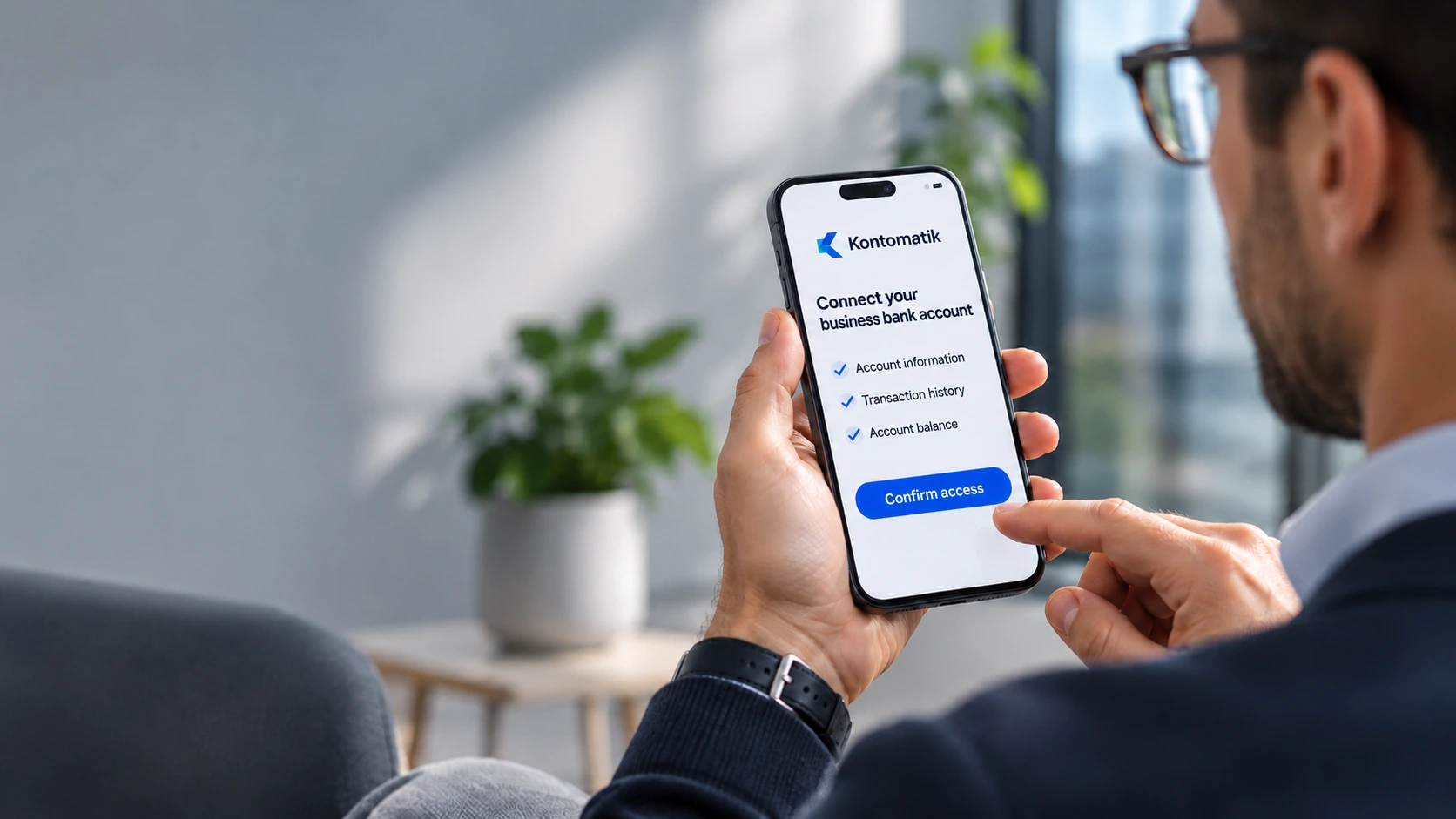
You apply for business financing, provide your company's details and specify the amount you need. At the next stage, you are asked to share information from your bank account using Kontomatik. Instead of submitting bank statements as PDF files, you can proceed with connecting your bank account. And that's when a perfectly reasonable question arises: what exactly will the financing provider see, and what information will they be able to access?
Open banking allows certain bank account data to be shared with the consent of an authorised user through services regulated by payment services legislation. Solutions such as Kontomatik can streamline financial verification by automatically retrieving and organising information about account balances and transactions.
However, this does not mean giving the financing provider unlimited access to your online banking. The information that can be shared depends on the scope of the service, the permissions granted, the data available from the bank and applicable regulations. In this article, we explain how the process works, what information may be analysed and what to check before giving consent.
What is open banking?
Open banking is a model that allows authorised third-party providers to access certain banking data or services. In the European Union, its development is linked to the PSD2 Directive and legislation governing access to payment accounts.
One of the services operating under this model is AIS (Account Information Service), which allows an authorised provider to access information about payment accounts with the user's consent and within the scope permitted for that service. This may include account balances, transaction histories and account holder information.
In Poland, these services are governed by the Payment Services Act, while AIS providers are subject to relevant regulatory requirements and supervision. More information is available from the Polish Financial Supervision Authority (KNF).
How is AIS different from payment initiation?
This distinction is important because open banking covers more than one type of service. AIS provides access to account information, while PIS (Payment Initiation Service) concerns initiating payments at the user's request.
Granting access to account information through AIS does not authorise a financing provider to make bank transfers. It is an information service, not a tool that allows a third party to independently use a business owner's money.
What is Kontomatik and how does it work?
Kontomatik is a provider of technology solutions that enable the retrieval and analysis of banking information. Its services are used in customer verification and financial assessment processes where bank account data is required.
In practice, business owners may encounter Kontomatik as part of a financing application or verification process. In this context, Kontomatik is not a loan or a separate financing product. It acts as a provider of account information services, allowing relevant data to be obtained and subsequently used by the institution assessing the application.
On its website for end users, Kontomatik explains that, following authorisation, it can retrieve, organise and analyse banking data before passing the relevant information to the partner through which the process was initiated.
How does connecting a bank account through Kontomatik work?
A typical process can be divided into five steps:
- Starting the verification process - during a financing application, the business owner is offered or required to share bank account data through Kontomatik.
- Selecting a bank - the user chooses the bank from which the information will be retrieved.
- Reviewing the access permissions and giving consent - the user should receive information about which data will be shared and why it is needed.
- Authentication - the user logs in or authorises access using the method supported by the bank, for example through its mobile banking app.
- Retrieving and sharing data - the service obtains the available information, and the recipient receives the data or a report within the scope of the particular process.
The exact procedure may vary depending on the bank and the solution used. It will not always look identical to a standard online banking login.
Before approving access, check which organisation is requesting the information, which accounts will be included and how long the access will remain valid. These details matter more than simply recognising the technology provider's name.
What bank account data can a financing provider see?
The information available through open banking depends on the bank, account type, selected service and consent granted. Kontomatik states that its AIS solutions can provide access to account holder details, payment account information, balances and transaction details, including amounts, dates and payment descriptions.
When assessing business financing, these records can help evaluate actual cash flows and how a company manages its ongoing financial obligations. However, this does not mean that a financing provider receives every piece of information available through online banking. The data shared must correspond to the particular service and the user's authorisation.
Can a financing provider see every transfer and payment recipient?
If transaction history is included in the data shared, it may contain details of individual transactions rather than only monthly totals of incoming and outgoing payments. Depending on the information supplied by the bank, transfer descriptions, dates, amounts and details of the other party to a transaction may be visible.
This means that sharing account history may allow individual transactions to be analysed, not just the company's overall revenue or cash inflows. Business owners should understand this before starting the authorisation process.
However, this does not mean that every transaction is automatically interpreted in a particular way. A payment reference alone is not always sufficient to determine the economic purpose of a transaction.
Does Kontomatik show the account balance in real time?
The information retrieved may include the balance available at the time of access and the transaction history, but this should not be confused with unlimited, continuous account monitoring.
Some account information services operate on a one-time basis, while others may allow information to be retrieved again over a defined period. Whether access is one-time or recurring depends on the specific service and the permissions granted.
One-time data sharing should not be presented as consent to monitor a business bank account indefinitely.
How far back can Kontomatik retrieve bank account history?
There is no single number of months that applies to every bank and every integration.
The available transaction history depends on factors such as the bank's capabilities, the authentication method and the solution used by the service provider. In its technical documentation, Kontomatik explains that some connections have limitations on retrieving older transactions and that obtaining more than 90 days of history may require additional authentication or another supported procedure.
In some cases, information covering a longer period may be available. However, it would be incorrect to promise that every connection automatically provides six or twelve months of transaction history.
It is also important to distinguish between the period covered by the retrieved transactions and the period during which the service is authorised to retrieve information again. These are two different things.
What do financing providers analyse using bank account data?
Bank account data can be a useful complement to a company's financial documents. It allows financing providers to review not only reported revenue but also the actual cash inflows and outflows recorded in the account.
Bank account inflows are not automatically equivalent to accounting revenue, just as outgoing payments are not automatically tax-deductible expenses. An account may contain transfers between a company's own accounts, refunds, loan proceeds or payments that do not qualify as accounting expenses.
That is why open banking data should be interpreted in the context of the company's financial situation rather than treated as a standalone financial statement.
1. Regularity of incoming payments
Transaction analysis can help determine whether a company receives payments consistently or whether a substantial proportion of its cash arrives during particular periods. This is especially important for seasonal businesses, project-based companies and businesses delivering larger contracts.
High cash inflows in one month do not necessarily indicate financial stability if the company receives significantly less money during the remaining months.
2. Recurring financial obligations
Account history may reveal regular outgoing payments related to salaries, rent, leasing, loan repayments or supplier settlements. This can help explain the scale of expenses incurred during normal business operations.
However, not every payment recorded in the account represents a recurring obligation, so the assessment should consider the nature of each transaction and any explanations provided by the business owner.
3. Cash flows and their variability
An account's closing balance alone does not explain how a company manages its cash throughout the month. A business may finish a period with a positive balance while experiencing significant cash shortages earlier.
Transaction data can help identify these fluctuations. A useful complement to this historical analysis is our 13-week cash flow forecast guide, which explains how to forecast future cash inflows, outflows and balances.
4. Existing financing commitments
Some transactions may indicate regular repayments of financial obligations, but bank account history does not necessarily cover all of a company's loans, credit facilities or other debt. Not every obligation has to be serviced through the account included in the analysis.
Bank account verification may therefore be supplemented with financial documents, information about existing obligations and data from relevant registers.
5. Consistency with other financial documents
A financing provider may compare bank account information with invoices, tax filings, financial records or explanations provided by the business owner. Discrepancies do not always indicate a problem, but they may require clarification.
For example, an invoice issued in a particular month does not necessarily mean that the payment reached the company's bank account during the same period. Bank cash flow analysis and accounting revenue analysis provide different but complementary information.
Example - what can an analysis of a business bank account reveal?
Suppose a service company is applying for financing to deliver a larger contract. Its financial documents show revenue of approximately PLN 200,000 per month, but the cash arriving in its bank account is uneven. Some customers pay late, while employee salaries and subcontractor payments must be settled regularly.
Let's look at a simplified three-month example. All figures are illustrative.
The company ends the third month with the same balance as at the end of the first month, but the underlying cash flows tell a different story. In the second month, cash inflows fell to PLN 140,000, while outflows totalled PLN 180,000. The business covered the difference using previously accumulated funds.
A single positive bank balance does not provide the full picture of liquidity. Analysing account history can help identify a company's need for a cash reserve during periods between fulfilling contracts and receiving customer payments.
At the same time, three months of account history alone are not enough to determine whether the company qualifies for financing. The assessment must also consider existing obligations, the financing purpose, future cash flows and other financial information.
Is Kontomatik safe to use?
The security of the connection to a bank is one of the most important concerns for business owners. Sharing account history means providing information about the company's operations, including incoming payments, expenses and certain commercial relationships.
Account information services are regulated, and their providers must comply with applicable requirements concerning secure communication, authentication and data protection. Kontomatik also describes its security and compliance measures on its official website.
However, the fact that a service is regulated does not mean users should approve every access request without reviewing it. Before authorising a connection, make sure the process was initiated through the correct financing provider and that the consent screen matches the information you expect to share.
Can Kontomatik transfer money from a business bank account?
AIS itself is not designed to make bank transfers. Access to account information does not automatically authorise the initiation of payments or the withdrawal of funds.
Nevertheless, it is important to check which specific service you are authorising, as open banking regulations cover different categories of payment services.
Does Kontomatik obtain online banking passwords?
There is no single answer that applies to every bank connection method. Under the standard PSD2 model using dedicated bank interfaces, authentication takes place with the bank. However, Kontomatik also describes alternative connection mechanisms used in certain circumstances, such as when a bank's standard interface is unavailable or not functioning correctly.
It would therefore be inaccurate to promise unconditionally that banking credentials never appear in a service provider's interface. The safest approach is to follow the information displayed during the specific authorisation process and never enter banking credentials into unexpected forms received by email or SMS.
Can the data be used without restrictions?
No. AIS providers are subject to rules governing the purposes for which account information may be obtained, used and stored. An AIS provider cannot freely use the data for purposes unrelated to the service being provided under an appropriate legal basis.
However, it is important to distinguish between the account information service provider and the financing institution that may receive the data during the application assessment. The rules governing further processing should be explained in the relevant privacy notices and legal disclosures.
Ending access to a bank account does not necessarily mean that all previously shared information will be deleted immediately. Data retention rules should be checked in the documentation provided by the relevant organisations.
Does a business owner have to share every company bank account?
That depends on the type of financing and the requirements of the particular process.
A business may use several bank accounts, for example to receive customer payments, settle obligations or manage foreign currency transactions. Analysing only one account may not always provide a complete picture of its cash flows.
On our B2B factoring and contract financing page, we identify connecting all business bank accounts used for transactions through Kontomatik as part of the process. For our growth loan, we specify the requirement to provide bank statements from business accounts covering the previous six months.
These two approaches should not be treated as identical verification procedures. The requirements concerning bank accounts and the way financial information is shared depend on the product.
What if a business owner does not want to use Kontomatik?
It is important to distinguish between declining consent to a particular service and being able to continue a financing application.
Users should be able to make an informed decision about sharing their banking data. However, this does not mean that every financing provider is required to offer an identical verification process without open banking. The necessary financial information remains an important part of risk assessment, and the availability of alternative submission methods depends on the financing product.
If a business owner has concerns, it is worth asking before authorisation whether bank statements can be submitted in another format and whether this would affect the assessment process.
Kontomatik vs traditional bank statements - what is the difference?
Traditional bank statements and information retrieved through AIS may serve a similar purpose: providing details of transactions recorded in an account. However, they differ in how the data is obtained, what information is available and how easily it can be processed automatically.
The main benefit of automated data retrieval is that it can reduce the manual work involved in gathering and organising financial information. However, open banking does not always replace every required financial document, nor does it mean that every application can be assessed without additional questions.
How do we use banking information in PaveNow's financing process?
At PaveNow, we analyse a company's financial position to assess its ability to service the proposed financing. Bank account information can form part of this assessment because it helps us understand the company's actual cash flows.
In our factoring and contract financing processes, we use Kontomatik to verify business bank account information. We require access to information concerning the accounts used for business transactions, in line with the requirements of the particular product. For our growth loan, we review business bank statements and other financial documents.
We do not assess a company solely on the basis of a single account balance. Existing obligations, the nature of the business, the purpose of financing and repayment capacity also matter. Sharing bank account data does not automatically result in approval or guarantee that a particular financing amount will be granted.
If you are preparing to apply for financing, you can also read our guide How Does the Business Financing Process Work Step by Step?.
Checklist - what should you check before connecting your account through Kontomatik?
Summary - open banking provides access to data, not money
Open banking can simplify the process of sharing financial information when applying for a business loan, factoring or another form of business financing. Kontomatik is one of the technology providers offering solutions for retrieving and analysing bank account information.
AIS may provide access to account details, balances and transaction histories, but the service itself does not allow a financing provider to make transfers. The scope of information depends on the specific process, bank and consent granted. There is also no universal period of transaction history that can be retrieved from every account.
For financing providers, bank account data can be a valuable complement to the assessment of a business. It helps analyse the regularity of cash inflows, spending patterns and cash flows, but it does not replace a complete financial analysis or a forecast of future obligations.
Before authorising access, it is worth reviewing the scope of consent and making sure the information being shared is appropriate for the verification process. Understanding what you are authorising makes the financing process more transparent and reduces uncertainty about access to your business bank account.