Financing products

September 4, 2026
Which documents should you prepare for a property-secured business loan?
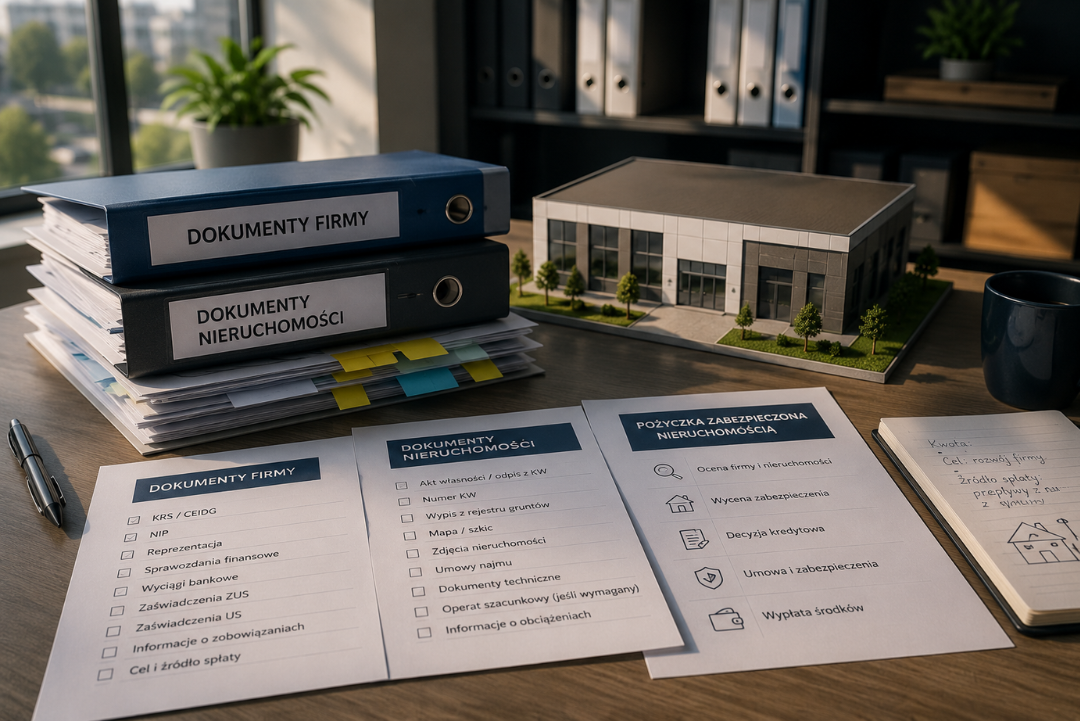
Documents for a property-secured business loan cover two separate areas. The first concerns the company, its authorised representatives, the purpose of the financing and the source of repayment. The second allows the lender to assess the property: its owner, legal status, encumbrances, value and suitability as collateral.
This does not mean that a business owner must compile a complete archive before the first conversation. Basic company details, the land and mortgage register number, a description of the property, the required amount and the business purpose are often enough to begin the assessment. Additional documents are requested when they are relevant to the type of asset, the way the company earns revenue, existing encumbrances or the structure of the transaction.
A well-prepared set of documents does, however, reduce the risk of the process stopping because the information is inconsistent. A different owner from the one named in the application, outdated company representation, an undisclosed mortgage or an area that does not match the records may matter more than one missing attachment.
Which documents are needed at the beginning of the process?
At the first stage, the lender needs enough information to determine whether the transaction meets the basic criteria and which documents will be required later. Collecting everything before this initial assessment can create unnecessary costs, such as ordering a property valuation report before confirming whether that form of valuation is required.
At PaveNow, the basic set includes the property's land and mortgage register number and the company's details: NIP, a KRS extract or a CEIDG entry. Depending on the circumstances, current certificates confirming no arrears with ZUS and the tax office may also be required. Under the RENT MAX option, lease agreements and business bank statements confirming rental income are assessed. A property valuation report may be optional if the property qualifies for an automated valuation model, or AVM. The current requirements are described on PaveNow's property-secured business loan page.
This is not an exhaustive list. Its purpose is to show the order of the process. A document required to execute and secure the agreement does not always have to be provided before the initial property assessment.
Company documents: registration, representation and financial position
Registration data shows which entity is applying for financing and who may act on its behalf. For a sole trader, the CEIDG entry is the starting point. For a company, the lender checks the KRS, representation rules, shareholders and beneficial owners. If the representation rules require two management board members to act jointly, one person cannot validly sign all documents simply because they are conducting discussions with the lender.
Paper printouts do not always have to be obtained separately. Business details can be checked in the public CEIDG and KRS business search, while a current company extract is available from the Court Registers Portal. The company should nevertheless make sure that the entries reflect the actual situation. An outdated address, a change in the management board or a former representative who has not yet been removed from the register may require clarification.
Financial documentation depends on the company's accounting method, the financing option and the repayment source. It may include:
- business bank statements for the specified period
- financial statements, the KPiR tax ledger, revenue records or tax returns
- a schedule of loans, credit facilities, leases, limits and other liabilities
- evidence of income linked to the proposed repayment source
- agreements, cost estimates, pro forma invoices or an investment schedule explaining the loan purpose
- a cash flow forecast if repayment depends on a future event or project
- current ZUS and tax office certificates if required for the transaction
A tax certificate can be requested electronically through e-Urząd Skarbowy. An application for a certificate confirming no arrears in social security contributions can be submitted through eZUS.
The documents should present one coherent picture of the transaction. The amount in the application should match the budget, and the proposed repayment source should be supported by historical data, agreements or a realistic forecast.
Property documents depend on the type of asset
An apartment, retail unit, warehouse and plot of land are not documented in the same way. The land and mortgage register number remains the main reference point, but it may not describe the entire situation. For land, zoning and cadastral data are important. For a commercial building, its permitted use, area and lease agreements may matter. If the property belongs to a third party, the owner's documents and participation in establishing the collateral are also required.
Not every document in the right-hand column will be needed in every case. It is better to provide the basic information first and then agree on a list tailored to the particular property.
The land and mortgage register number is the starting point
Anyone who knows the KW number can view the current contents of the register free of charge through the Ministry of Justice Electronic Land and Mortgage Registers. The lender checks more than the registered mortgage. The property description, owner, third-party rights, claims, restrictions and references to pending applications are also relevant.
A screenshot of the register may be insufficient if the basis of ownership, a change in plot designation or inconsistent information needs to be explained. The Central Land and Mortgage Register Information Office also allows users to obtain a complete copy or an extract covering selected sections.
When is an extract and cadastral map from the land and building register required?
The land and mortgage register shows the legal status, while the land and building register contains descriptive data about plots, buildings and premises. An extract or cadastral map may be needed when the lender or valuer must confirm the designation, area, land use, boundaries or building data.
These documents do not need to be ordered automatically for every property. For a standard unit, the register and other available materials may be sufficient at the beginning. Cadastral documents become considerably more useful for a plot, a house, several plots forming one property or discrepancies between registers.
The application is submitted to the district authority or city authority with district rights for the property's location. Some authorities allow online applications. The document may be obtained by the owner, a person entitled to dispose of the property or an entity with a legal interest. The process is explained on the Polish government page for obtaining an extract and cadastral map from the land and building register.
What should you prepare if the property does not belong directly to the company?
The property may belong to the company, a sole trader, a shareholder, a spouse or another person. The owner of the collateral and the borrower are therefore not always the same entity.
If the property belongs to a third party, the assessment must establish:
- who owns the property and how they acquired it
- the owner's relationship with the company seeking financing
- whether the owner understands the terms and consents to the establishment of collateral
- whether the property forms part of a spouse's separate property or the spouses' joint property
- who must participate in the transaction and sign the documents
- whether powers of attorney, resolutions or consents are required in the particular case
Providing the KW number alone does not replace the owner's participation. The person providing the collateral may be asked for identification, the title document, information about marital status or the matrimonial property regime, and any required consents. The exact scope should be confirmed with the lender and the notary before finalisation.
Which documents are needed when a mortgage already exists?
An entry in Section IV does not always show the current amount outstanding. A mortgage may secure a claim up to a specified maximum sum, while the current balance of the obligation is lower. It may also remain in the register after repayment if the discharge process has not been completed.
Where an existing encumbrance is present, the following may be required:
- the agreement or basic information about the obligation secured by the mortgage
- a current certificate from the creditor confirming the outstanding balance
- the bank account details and full repayment conditions if part of the new financing will settle the earlier obligation
- consent to discharge the mortgage or a document specifying the conditions for issuing that consent
- information needed to establish the ranking of security interests
The property's value is not the only factor. The debt already secured against it also matters. This is explained in more detail in our guide to calculating LTV in a business loan.
The PaveNow PRIME option requires a first-ranking mortgage and the property cannot be encumbered by other loans. Under other options, an existing mortgage is assessed individually. A company should therefore assume neither automatic disqualification nor guaranteed refinancing without first providing current information.
Is a property valuation report always required for the loan?
Not always at the beginning. PaveNow lists the valuation report as optional if the value is not determined using an AVM. The valuation method depends on factors including the selected option, location, property type and availability of reliable data. A non-standard production facility, mixed-use property or asset requiring a more detailed assessment may require additional documents or verification by an inspector.
A property valuation report is prepared by a licensed valuer for a specific purpose. A company should not assume that every valuation it already holds will be accepted without further review. The date, stated purpose, scope, condition of the property and changes in market or legal circumstances are relevant.
Under Article 156 of the Polish Real Estate Management Act, a valuation report may be used for the purpose for which it was prepared for 12 months from its date, unless changes affecting its validity occur earlier. After this period, the valuer who prepared the report may confirm that it remains current. Before commissioning a valuation, it is therefore worth confirming with the lender which form and purpose will be accepted. Read the Polish Real Estate Management Act
Documents relating to rental income and the repayment source
The property can serve as collateral, but it does not replace a source of repayment. If the loan is to be serviced from the company's ongoing operations, the lender needs information showing its cash flows. If rent is the repayment source, the assessment should connect the lease agreements with the actual receipts.
Eligibility for PaveNow RENT MAX is based on rental income and DSCR. Lease agreements and business bank statements confirming rental income are therefore required. Depending on the property, the following may also be useful:
- amendments changing the rent, term or leased area
- a schedule of tenants and lease expiry dates
- information about arrears, deposits and rent-free periods
- property maintenance costs paid by the owner
- a reconciliation of receipts if payments have inconsistent descriptions
A lease stating a monthly rent of PLN 20,000 does not by itself prove that this amount is received regularly. Transfers without a clear description may in turn need to be matched to specific tenants. It is best to prepare a schedule linking the agreement, invoice or debit note and the payment received into the account.
What most often delays the document review?
The number of files is rarely the only problem. More time is usually spent establishing why the documents do not describe the same situation.
Concealing an issue does not make the process shorter. If the company knows about a discrepancy, it is better to describe it at once and explain whether a register update, document request or discussion with the current creditor is in progress.
How should you organise the documents before applying?
Preparation can begin without incurring any costs. Start by checking public registers and collecting information the company already holds.
- Check the current CEIDG or KRS entry and the company's representation rules.
- Record the full land and mortgage register number and review its current contents and pending application references.
- Identify the owner, matrimonial property regime and people who must participate in the process.
- Collect information about all mortgages and the current outstanding debt.
- Describe the property: type, address, area, use, condition and rental income.
- Define the required amount, its purpose and the proposed repayment source.
- Prepare financial data and statements showing the company's current cash flows.
- Compare the information in the documents and list any discrepancies that require clarification.
- Ask the lender whether cadastral extracts, maps, a valuation report or additional technical documents are needed.
- Only then order materials that are costly or time-consuming to obtain.
File names should include the document type, property and date, for example KW_unit_Warsaw_2026-08-27.pdf or mortgage_balance_bank_2026-08-25.pdf. Financial documents can be separated from property materials, and old versions should be clearly marked. This makes it easier for both parties to confirm that the current version is being assessed.
Documents required by PaveNow
Sole traders, limited liability companies and joint-stock companies registered in Poland may apply for a PaveNow property-secured business loan. The company should have operated for at least 12 months, and the funds must be used for business purposes. Residential and commercial properties may be assessed. Agricultural land larger than 0.3 ha is excluded from the product.
To start the process, it is worth preparing:
- the company's NIP and CEIDG or KRS details
- the property's land and mortgage register number
- the required amount and financing purpose
- information about existing debt secured against the property
- current ZUS and tax office certificates if required for the company
- for RENT MAX: lease agreements and business bank statements confirming rental income
- an existing property valuation report if an AVM is not used
Depending on the option and the property, PaveNow may request additional documents or verification by an inspector. Initial qualification does not guarantee that a loan will be granted. The final amount, LTV, term, cost and collateral depend on a full assessment of the company, property and documents.
A complete document set should explain the transaction
Documentation is not collected only to prove that the company and property exist. It should show who is assuming the obligation, who is providing the collateral, what the property is worth, which liabilities already encumber it, how the money will be used and how the company intends to repay it.
Many documents can be checked or obtained online. Costly materials, such as a property valuation report, are best commissioned after the required scope has been agreed. Known discrepancies should not be left until finalisation, because they are usually the issues that require the most additional explanation.
A company that begins with the KW number, current registration data, information about existing debt, the financing purpose and the repayment source gives the lender a basis for preparing the correct document list. The remaining requirements then follow from the particular property and transaction.