Financing products

May 5, 2026
How Does Business Financing Work Step by Step - From Application to Payout?
.png)
For many companies, the biggest barrier before applying is not the cost of financing itself, but uncertainty. What will need to be prepared? How long will it take? When is the decision actually made? And at what point does the money really reach the company, the contractor, ZUS, or the tax office?
These are important questions because, in business financing, the biggest stress usually does not come from the product itself, but from not knowing what happens next. A business owner sees promises of a fast decision and a simple process, but does not always understand what happens between clicking "apply" and the actual payout of funds.
In practice, the financing process does not look the same for every product. Factoring works differently from a growth loan. A bridge loan for ZUS and tax liabilities works differently from real estate secured financing. Even so, the process can still be organized into a simple framework that helps explain what to expect and what really affects the pace.
What happens first - before any decision is made
The first stage is usually an initial qualification step or a simple contact form. Depending on the product, this part can take just a few minutes. With a growth loan, it starts with a short online qualification. This is the moment when the company provides basic information about itself and its financing need. At this stage, the goal is not a full analysis yet, but a quick check to see whether the case makes sense from the start. For the business owner, this matters because it helps avoid wasting time on a process that does not fit the company profile or the purpose of financing.
At this stage, a few things matter most:
- which product you are interested in,
- what you need the funds for,
- how your company operates,
- and whether the financing need looks like a real business case rather than a chaotic attempt to patch everything at once.
Step two - the full application and the data needed for analysis
Only after the first step comes the stage that most companies think of as the "real application." This is where financial data, documents, and the information needed for risk assessment come in.
With a growth loan, you provide more detailed information about the business and any assets that may serve as collateral. At this point, documents are also needed to properly assess the company’s situation, such as bank statements or certificates confirming no outstanding liabilities to ZUS and the tax office.
Other products work a little differently. With a bridge loan for paying off ZUS and tax liabilities, the process is simpler and focuses only on what is necessary to assess the debt and the company’s ability to settle it. This usually means bank statements, information about liabilities to ZUS and the tax office, and basic financial data.
Factoring starts from a different point altogether. The process is built around a specific invoice or contract. At the beginning, the document, the contractor, and the payment terms are checked. With a first transaction involving a new contractor, there may also be a review of the agreement to verify whether there is a prohibition on assigning receivables.
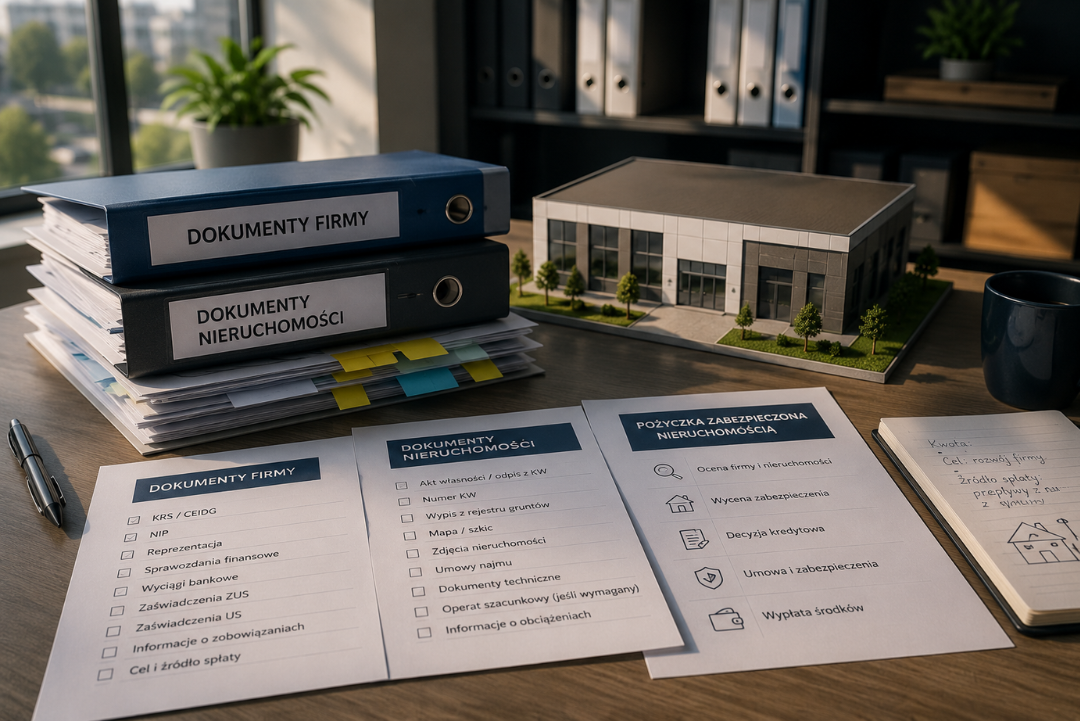
With real estate secured financing, the property itself becomes important from the start alongside the company data. In that case, the analysis is not only about the current business situation, but also about the type of collateral, its value, and how it fits into the financing case as a whole.
Step three - analysis and decision
This is the stage companies are usually most nervous about, because this is where the answer finally appears: is financing available, and on what terms?
In practice, the analysis is not only about checking whether the company exists or has a business history. It is more about assessing whether there is a logical case behind the financing, whether the company can handle the obligation, and whether the selected product actually fits the situation.
The speed of the decision depends mainly on three things:
- the type of product,
- how complete the documents are,
- and how complex the case is.
With a growth loan, the analysis ends with a specific decision and offer, and once the documents are signed, the funds can usually reach the company quickly.
With a bridge loan for ZUS and tax liabilities, the decision is usually made quickly as long as the data is complete from the start and the case is clear.
With real estate secured financing, the valuation of the collateral becomes part of the process, so even when the decision is fast, the overall path may look different than with simpler products.
In factoring, what matters is not only the company itself, but also the contractor, the invoice, and the terms of cooperation between the parties.
This distinction matters. A fast decision does not mean every case looks the same. It usually means that if the data is complete, the case is understandable, and the product is well matched, the process does not need to drag on for weeks.
Step four - signing the agreement and releasing the funds
From the outside, this stage can look like a formality, but in practice it is crucial. This is the moment when a general approval becomes a concrete offer, repayment structure, and the actual release of money.
With a growth loan, this is the point where the process moves from analysis to a specific offer, signing the agreement, and transferring the funds to the business account.
With a bridge loan, the payout looks different, because the funds are not simply sent for any purpose. They are directed toward paying off the indicated liabilities to ZUS or the tax office.
In factoring, once the transaction is approved and the verification and receivables assignment steps are completed, the funds are released against the specific invoice, and then payment from the contractor is awaited.
This is where it becomes especially clear that "payout" does not always mean the same thing. Depending on the product, the funds may:
- go directly to the company account,
- be released against a specific invoice,
- or be used directly to repay a liability.
Why one process takes 1 day and another takes 5 days or longer
From the business owner’s perspective, this is one of the most important questions. And the answer is simpler than it often seems: the difference usually does not come from the lender’s whim, but from the nature of the product itself.
The simpler and more one dimensional the case is, the faster it can usually be assessed. That is why invoice financing or a bridge loan for a specific liability may move faster than a product that requires property valuation or a broader review of the company’s repayment capacity.
With real estate secured financing, the collateral itself adds another layer, including the type of asset and parameters such as LTV. With a growth loan, the analysis covers not only the company’s current condition, but also the purpose of the financing. With factoring, the contractor, the invoice, and the issue of whether receivables can be assigned also matter.
What most often slows the process down
The most important thing to remember here is that the process is often slowed down not by the analysis itself, but by a lack of readiness on the company’s side.
The most common blockers are:
- incomplete documents,
- no clear financing purpose,
- inconsistencies between the application and the documents,
- delayed replies to additional questions,
- or choosing a product that does not actually fit the business need.
If a company submits an application "just to see what happens," without proper preparation, the process almost always becomes longer. If, on the other hand, it is clear from the start why the funds are needed, what data will be required, and which product matches the situation, everything tends to move much more smoothly.
How to prepare for the process without losing time
The best move is not to look for "fast financing" blindly, but to prepare in a way that lets the financing institution immediately see the logic of the case.
In practice, it helps to have ready:
- the basic information about the company,
- up to date bank statements,
- a clear explanation of the purpose of financing,
- documents related to the invoice, liability, or collateral, depending on the product,
- and a simple answer to the question: what exactly should improve once the financing is in place?
This does not just speed up the analysis. It also helps the company itself make a more organized decision.
The financing process should not feel like a mystery
The biggest problem in business financing today is not that the process is always long or complicated. The problem is that many companies enter it without knowing what to expect.
A well structured process should answer four simple questions:
- what needs to happen at the start,
- what data is required,
- when the decision is made,
- and when the funds are actually available.
The better a company understands those four stages, the less space there is for chaos, guesswork, and unnecessary delays.
Summary
The biggest barrier in financing is often not the application itself, but the lack of clarity about what happens next. When a company does not understand the path from first contact to payout, it becomes easy to delay the decision or enter the process with unnecessary tension.
That is why financing should not be seen as one "fast decision," but as a structured process. The better the company understands what a given product requires, which data will be needed, and what affects the pace of analysis, the easier it becomes to move through the whole process without chaos or wasted time.
A well designed process should not only be fast. It should be understandable, predictable, and suited to the company’s real situation. That is when financing stops being a source of uncertainty and becomes a tool that helps the business make a concrete move.