Financing products

Discover CFO Suite
Get Started
The client was a specialised construction company using scaffolding designed for work at height. The business required PLN 800,000 in financing, and its specialised equipment could serve as collateral for the transaction. The intended security was a registered pledge over the scaffolding. Establishing this pledge requires registration in the relevant register, and the process can take up to 60 days, depending on how quickly the court processes the application. However, the client needed access to part of the funds sooner. PaveNow structured the financing and security arrangements in stages. The initial PLN 100,000 was disbursed while the registration process was still underway. Once the registered pledge had been established, the client received the remaining PLN 700,000. In total, the company secured PLN 800,000 without having to wait for the entire process to be completed before receiving its first disbursement.
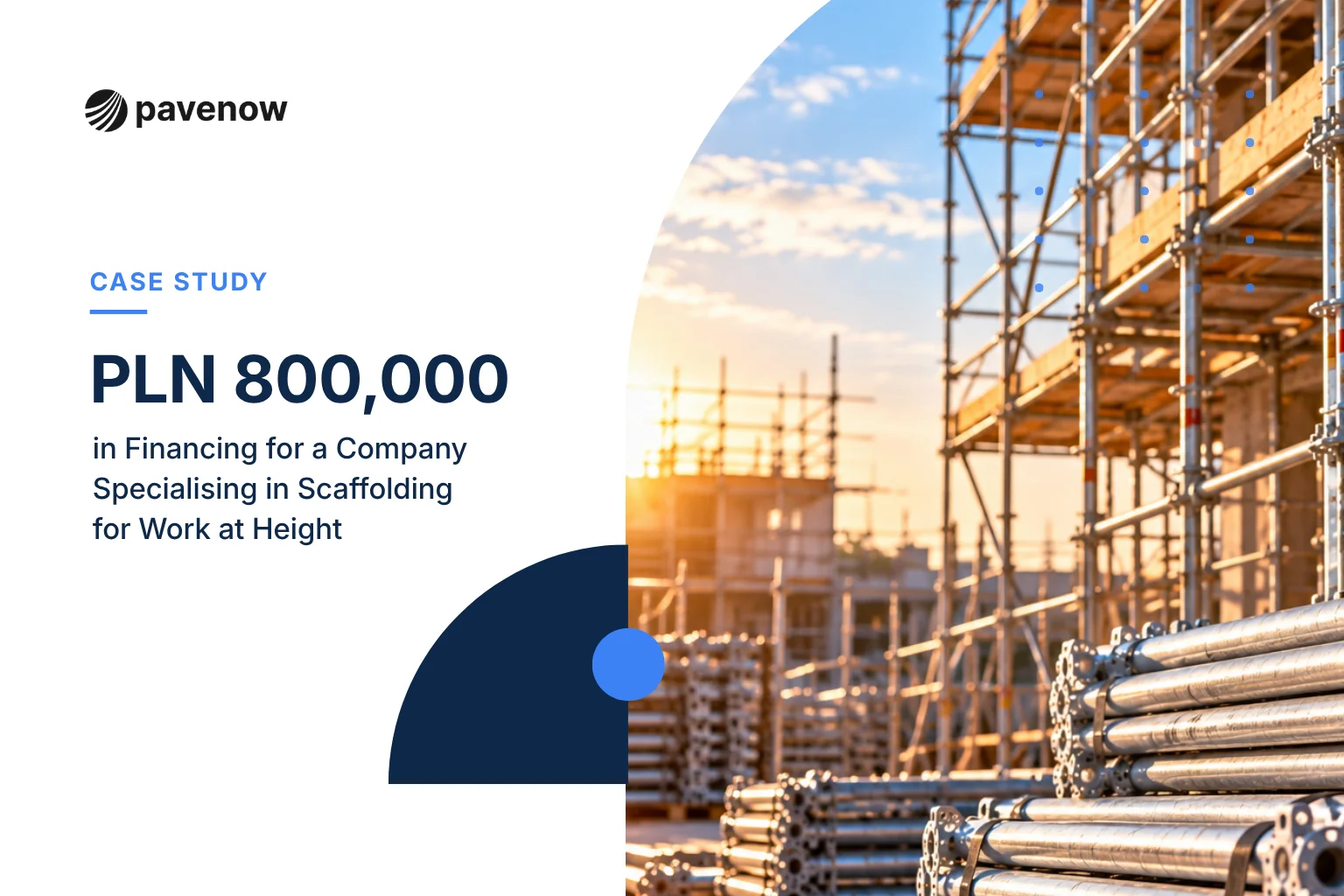
The client was a construction company specialising in scaffolding used for work at height.
Its specialised equipment was an important part of the business. The scaffolding had tangible value and could be used as collateral to secure a larger financing facility.
This provided the basis for structuring a PLN 800,000 transaction, with a registered pledge over the equipment serving as the final security.
Establishing a registered pledge involves a court registration procedure, and the waiting period for registration can extend to 60 days. For the client, this meant potentially waiting two months before the full financing amount could be disbursed.
Yet part of the capital was needed sooner.
The challenge was therefore not the availability of financing itself, but the gap between the time required to establish the final security and the point at which the company needed its first funds.
PaveNow needed to structure the transaction so that the pledge registration process could proceed without preventing the client from accessing capital in the meantime.
PaveNow combined staged disbursements with a phased approach to establishing security.
The first stage addressed the client's immediate financing needs while the process of establishing the final registered pledge was still underway. At the same time, the remaining steps required to secure the larger amount were being completed.
Once the registered pledge over the specialised scaffolding had been established, the second stage of financing could be disbursed.
This meant that the time required for the court registration procedure did not leave the company without access to capital throughout the waiting period. The key was not only the amount of financing available, but also how the transaction was structured.
The staged structure allowed the client to access part of the required capital without waiting for the final registered pledge to be established.
Meanwhile, the process of securing the larger amount continued. Once it was completed, the company received the remaining funds.
As a result, the client obtained a total of PLN 800,000, with the disbursement schedule aligned with the actual progression of the transaction. The time needed to establish the pledge did not prevent the company from accessing its initial financing.
When financing is secured against business assets, it is not only the value of those assets that matters, but also the time required to establish the security.
A company may own valuable equipment or machinery that can serve as collateral for a larger financing facility, while needing access to part of the capital before the entire security process can be completed.
In such situations, it is worth considering not only the total financing amount, but also the timing of the company's funding needs. An appropriately structured transaction may make it possible to combine earlier access to part of the funds with a larger asset-backed financing facility.
In this case, the company did not have to choose between meeting an urgent funding need and waiting for the final security to be established.