Financing products

August 10, 2026
Business loan for a limited liability company - how to prepare for financing

A Polish limited liability company, or sp. z o.o., can take out a business loan and use bank credit, factoring, leasing, or capital provided by its shareholders. Its legal form alone does not determine whether funding will be available or what level of debt will be safe. A financing provider assesses the specific business: how the company earns money, how quickly sales turn into cash, its existing debt, the purpose of the new financing, and the realistic source of repayment.
This distinction matters because a company can show a profit and still have no cash available for an instalment. It can also grow quickly while using its own funds to cover long customer payment terms. Conversely, high turnover does not necessarily indicate security if sales depend on a single customer or generate too little margin.
A shareholder loan can be an alternative to external capital. It gives the parties considerable flexibility in setting the terms, but it ties up the owner's private liquidity and requires a properly drafted agreement, correct company representation, and an assessment of the tax implications. Nor does it automatically solve the company's problem. The company still needs to know when and from what source the loan will be repaid.
Can a limited liability company obtain a business loan?
Yes. A limited liability company is a separate legal entity and can enter into financing agreements in its own name. The borrower is the company, not its shareholders. This does not mean, however, that a financing provider looks only at the KRS registration, share capital, and annual turnover.
The assessment of a company usually covers two levels. The first is the condition of the business: sales, margin, cash flow, debt, payment history, and the purpose of the financing. The second is the entity's structure: its shareholders, beneficial owners, management board, representation rules, and links to other companies.
This is an important difference compared with a sole proprietorship. The company is a separate entity, but specific individuals make decisions on its behalf. The financing provider needs to know who controls the business, who can sign the agreement, and whether taking on the liability requires consent under the law, the articles of association, or a shareholders' resolution.
Ultimately, not only the level but also the quality of revenue matters. A company with PLN 5 million in sales may be more difficult to finance than a business with PLN 2 million in turnover if most of its inflows depend on a single customer, receivables are paid with long delays, or the margin is insufficient to service the instalments.
A financing provider will therefore look for answers in five key areas:
- whether the company conducts genuine business activity and has a track record that allows its performance to be assessed
- whether inflows are recurring and the loss of one customer would not deprive the company of its source of repayment
- whether margin and cash flow are sufficient to cover current operations, existing debt, and the new instalment
- whether the amount and term match a specific purpose
- whether the ownership structure, representation, and documents are clear and consistent
Meeting the initial criteria allows the assessment to begin, but it does not guarantee a positive decision. Turnover is only the starting point. For the financing to be safe, what matters more is how sales turn into cash available for repayment.
Why might a limited liability company need financing?
"Capital for growth" is too broad a description to select the right product and repayment schedule. The company should first determine exactly what creates the need for funding, when the money will be used, and which business event is expected to replenish it.
For example, a company may have signed a profitable contract but need to buy materials and pay subcontractors two months before receiving its first payment. The problem is not a lack of profitability, but a mismatch between the timing of costs and inflows.
Another business may want to buy a machine that will increase production capacity only after it has been commissioned and additional orders have been secured. In this case, the company needs to establish whether its existing operations can support the instalments until the investment starts generating an additional margin.
Another company may have funds tied up in issued invoices. A standard loan will not always be the best solution because the need is linked to a specific receivable and may be better addressed through invoice financing.
Financing makes sense when it closes a defined gap and there is a predictable way to repay it. It should not merely postpone an unresolved problem. If the company needs new capital every month to cover the same shortfall, it should first examine its margin, fixed costs, payment terms, inventory, and existing debt structure.
Which sources of financing can a limited liability company consider?
Once the need has been identified, the company can compare sources of capital. The mere availability of money should not determine the choice. Cost, term, collateral, balance sheet impact, repayment method, and the ability to obtain further financing in the future also matter.
A business loan or bank credit provides capital that the company repays according to a schedule. This may suit inventory, investments, or a project that will produce benefits gradually. The instalment must still fit within cash flow if the financed purpose starts delivering results later than expected.
Factoring does not finance an arbitrary expense. It accelerates cash from a trade receivable. It may therefore be better suited to a company that sells on deferred payment terms than another loan that must be repaid regardless of when the invoice is paid.
Contract financing is based on a signed agreement and the expected receivables from its performance. The assessment needs to consider not only the value of the contract, but also its margin, cost schedule, acceptance conditions, and the risk of delays.
Leasing links financing to a specific asset. It can preserve some of the company's cash, but the initial payment, total charges, buyout amount, insurance, and restrictions associated with ownership of the asset all need to be compared.
Shareholder capital, additional shareholder contributions, or an increase in share capital can strengthen the company over the long term without creating a typical monthly instalment. The cost is the shareholders' commitment of funds, corporate formalities, and, if a new investor is involved, a possible change in ownership and control.
Some projects require a combination of sources. A shareholder contribution may cover part of the investment, with external financing covering the remainder. The company should calculate the total burden and disclose every liability, including those owed to related parties.
Shareholder loan or external financing?
A shareholder loan can be a natural choice at the start of operations, when the need is urgent, or when a shareholder has capital that is not temporarily required elsewhere. The parties can set the amount, term, and repayment method to suit the company's circumstances. They do not undergo an external assessment, but they still need a proper agreement and an economic justification for the terms.
The main limitation is the source of the funds. Every zloty lent to the company reduces the shareholder's liquidity and increases their exposure to a single business. If the owner finances the company from private savings without a defined limit, it is easy to mistake a temporary need for a business that continually consumes new capital.
External financing allows shareholders to retain their funds and may provide a larger amount. In return, the company submits documents, undergoes an assessment, and accepts the cost and any collateral requirements. The assessment process itself can have value: it forces the business to define the purpose, demonstrate the source of repayment, and test its assumptions against its actual results.
The choice does not have to be binary. A company can finance part of a project with shareholder funds and part with external capital. This structure is safe only if the combined repayment schedule fits within cash flow and the financing provider knows the balances and terms of all shareholder loans.
What should a company know about a shareholder loan?
The loan should be documented. The agreement should specify the parties, the amount, how the funds will be transferred, whether interest is charged, the repayment date and terms, any early repayment option, and any collateral. A bank transfer described simply as "funding the company" is not a substitute for proper documentation.
A loan granted to a company by its shareholder is exempt from the Polish tax on civil law transactions, or PCC. This is confirmed by Article 9(10)(i) of the Act on Tax on Civil Law Transactions and the current Ministry of Finance information on PCC reliefs and exemptions.
The PCC exemption does not exhaust the tax consequences. Interest, interest settlement, the shareholder's status, VAT, income tax, and obligations relating to transactions between related parties require a separate assessment. A practical discussion of these issues is available in Interia's article "Loan from a shareholder to a limited liability company - what about taxes?". For a significant amount, an interest-free loan, or unusual terms, it is worth obtaining individual advice from a tax adviser.
Particular care is required when the shareholder granting the loan is also a member of the management board. Under Article 210 of the Polish Commercial Companies Code, in an agreement between the company and a member of its management board, the company is generally represented by its supervisory board or an attorney appointed by a resolution of the shareholders' meeting. Additional rules apply to a single-shareholder company when the sole shareholder is also the sole member of the management board. The representation rules should be verified before the agreement is signed and the funds are transferred.
What does a financing provider really assess in a limited liability company?
A financial assessment is not a contest for the highest turnover or the most polished financial statements. Its purpose is to determine whether the company can pay the instalment on time, including when some assumptions do not go according to plan.
How does revenue turn into cash?
Sales may be the starting point, but the financing provider looks further. It checks how long the company waits for payment, how much money it holds in inventory, when it pays suppliers, and whether this cycle repeats predictably.
Two businesses with the same revenue can have completely different liquidity. One collects deposits and receives payment within seven days. The other buys materials upfront, performs the service for two months, and then waits another 60 days for payment. The second company needs significantly more working capital despite generating the same sales value.
How much remains after costs and existing debt?
Revenue does not repay an instalment by itself. The company needs a surplus after payroll, taxes, ZUS contributions, suppliers, fixed costs, and instalments on existing liabilities. The financing provider may therefore assess margin, operating profit, seasonality, and one-off items.
A one-off loss does not necessarily rule out financing if it has a clear explanation and does not undermine liquidity. A seemingly positive result that is not supported by cash, or a margin too low to absorb even a short customer delay, can be a greater concern.
How significant is concentration risk?
The share of revenue generated by the largest customers indicates how dependent the company is on individual relationships. A customer responsible for 60% of sales may be stable and pay on time, but the loss or delay of a single contract will immediately affect repayment capacity.
Concentration does not always rule out financing. It does, however, require answers to further questions: how long has the relationship lasted, how long does the contract run, is there an order book, what are the termination terms, and can the company replace the customer?
Which liabilities already burden the company?
The full picture includes bank credit, loans, leases, used credit limits, recourse factoring, arrears, guarantees, and shareholder loans. A financing provider looks not only at the monthly instalments, but also at maturity dates, collateral, and the risk of several repayments falling due at the same time.
Omitting a liability does not improve the company's position. It can delay the process, change the offer, or undermine the credibility of the remaining data. A strong presentation shows all debt and explains which liabilities will expire, which will remain, and how the new financing will affect the total burden.
Does the purpose create a credible source of repayment?
The purpose should not be merely a label on the application. For a contract, the company needs to show the schedule of costs, invoicing, and inflows. For a machine, it should estimate the commissioning period, additional output, demand, and margin. For inventory, turnover and the risk of discounting unsold goods matter.
The strongest application brings the amount, timing of the expenditure, and source of repayment into one plan. If the company needs PLN 300,000 for a project, the cost estimate, schedule, and cash flow forecast should all explain exactly that amount, rather than presenting three different versions of the investment.
Are difficult events explained?
Arrears, enforcement proceedings, a drop in sales, or an unusual transfer do not always have to end the assessment. Their scale, cause, current status, and impact on future liquidity matter. An arrear that has been settled and is supported by evidence of payment is different from a problem that continues to grow without a plan to resolve it.
A company does not build credibility by hiding weaker periods. It builds credibility by presenting the data, providing a logical explanation, and showing what has changed since the problem occurred.
Does the track record of shareholders and management matter?
It can matter, but the scope of the assessment depends on the product, process, and collateral. A limited liability company is a separate entity, but specific people control and represent its operations.
Checks may cover beneficial owners, representation rules, the experience of the management board, links to other companies, and the individuals providing collateral. If the company is young, the management team's competence and the history of businesses previously run by them may help explain the plan, but they will not always replace the company's own financial data.
Cash flows between related parties may also be relevant. If the company sells mainly to another business owned by a shareholder, lends money to other group entities, or regularly transfers funds without a clear reference, the financing provider will want to understand the economic rationale and the impact on liquidity.
Limited shareholder liability does not mean that the people behind the company will not be checked. Nor does it automatically mean that a shareholder is personally liable for every loan taken out by the company. The scope of liability follows from the law, the individual's role, the agreement, and any guarantees or other collateral provided.
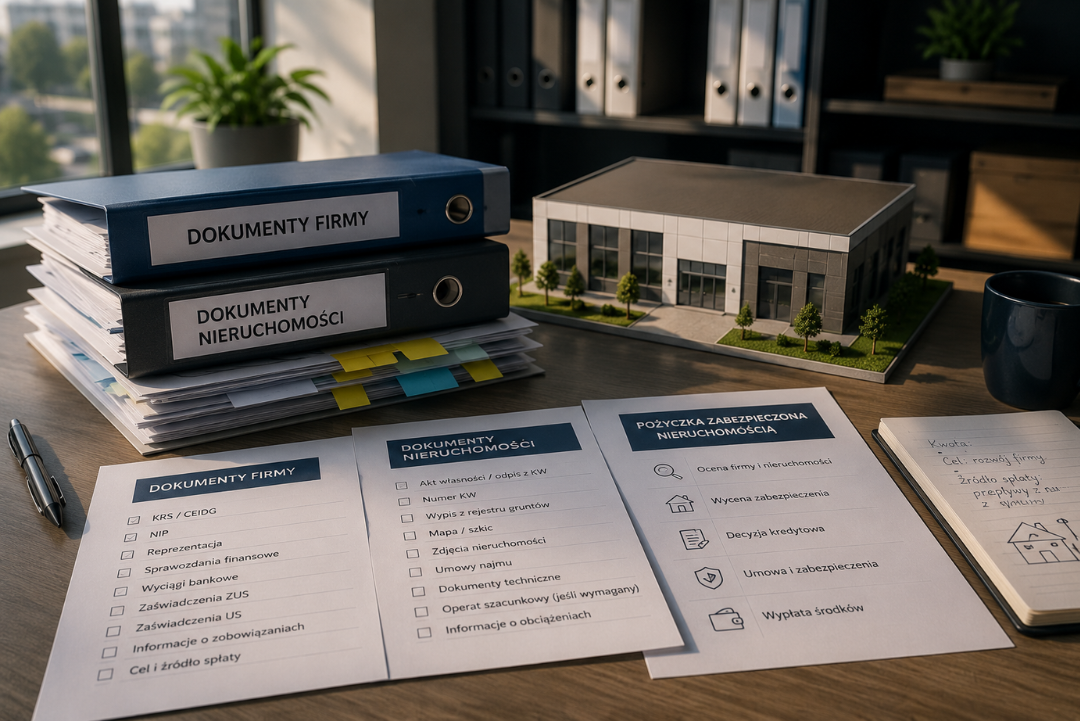
Which documents are required for a business loan for a limited liability company?
The list depends on the product, amount, operating history, accounting method, and collateral. It is useful to view documents not as a formal list of attachments, but as evidence answering specific questions asked by the financing provider.
Who is taking on the liability and who can sign the agreement?
Current KRS data, the articles of association, the shareholder structure, beneficial ownership data, resolutions, and powers of attorney serve this purpose. The documents should confirm the representation rules and indicate whether a specific amount or type of transaction requires additional approval.
How does the company earn and how much cash does it actually generate?
The answer can be found in the financial statements, current balance sheet and profit and loss account, current-year figures, and statements from all business bank accounts. Statements do more than confirm turnover. They show the rhythm of inflows, costs, use of credit limits, liability payments, and the minimum cash balance.
Which financial burdens already exist?
A schedule of bank credit, loans, leases, credit limits, factoring, guarantees, and collateral may be required. It should also include financing provided by shareholders and related parties. For each liability, it is helpful to show the current balance, instalment, maturity date, and collateral.
What supports the amount requested?
The purpose may be evidenced by agreements, orders, invoices, supplier quotations, cost estimates, schedules, or an investment budget. If the financing concerns a contract, the signed document alone may not be enough. Acceptance conditions, invoicing dates, delivery costs, and the expected margin are also important.
What will happen to cash after the financing is disbursed?
A cash flow forecast should show the receipt of funds, their use, current costs, taxes, existing instalments, and repayment of the new liability. The most useful forecast includes a base case and a conservative case, with assumptions that can be linked to the company's agreements and track record.
Are there arrears or formal obstacles?
A financing provider may require certificates confirming that the company has no outstanding tax or ZUS contribution liabilities. If the company has had arrears, an instalment arrangement, or a dispute, it is worth presenting the current status, proof of payments, and the matter's impact on liquidity from the outset.
The most common problem is not one missing document. It is an inconsistent story: one amount in the application, another in the cost estimate, an omitted liability, and a forecast that does not include the full instalment.
How can a company calculate a safe amount and instalment?
The maximum available offer is not the same as a safe amount for the company. The need should be calculated from the project's perspective and the instalment from the cash perspective.
The first step is to include the full budget. For a machine, this may cover not only the purchase price, but also transport, installation, training, adaptations to the premises, a stock of materials, and the commissioning period. Omitting related costs may leave the company with debt but unable to complete the investment without depleting working capital.
The next step is to determine how much of the company's own funds can be committed without eliminating its buffer. An own contribution reduces debt, but using all available cash leaves the company unprotected against a customer delay, a tax payment, or an unexpected cost.
The final step is to apply the full instalment to monthly cash flow. An annual average is not enough. The company needs to examine weaker months, seasonal expenses, tax deadlines, repayments on existing liabilities, and a possible delay before the investment produces results.
For example, a company generates an average monthly surplus of PLN 45,000 after current costs and existing liabilities. The new instalment will be PLN 24,000. In the base case, PLN 21,000 remains. If lower inflows and higher costs reduce the surplus to PLN 19,000, the instalment creates a PLN 5,000 shortfall.
This result does not automatically mean abandoning the project. It does show that the current structure is too tight. Possible adjustments include a smaller amount, a larger own contribution that still leaves a safe buffer, a different schedule, phasing the investment, or a product whose repayment better matches the timing of inflows.
A safe instalment is not one the company can pay in its best month. It is one that allows the business to keep operating in a realistic weaker scenario.
Can a new limited liability company obtain a business loan?
A new company may be able to obtain financing under some offers, but the issue is not the KRS registration date itself. The issue is the lack of evidence showing whether the model works and generates cash.
A forecast shows the plan, while the bank account history shows its execution. If the company has not yet operated for several months or longer, the financing provider may not know how quickly it acquires customers, what its seasonality looks like, whether customers pay on time, and whether the assumed margin is achieved in practice.
In this situation, the following become more important:
- signed contracts and orders from credible customers
- the shareholders' own contribution and willingness to share the risk
- the management team's experience in the same industry or business model
- the track record of a business transferred from a sole proprietorship or another entity, if continuity can be demonstrated
- a realistic budget with a reserve, not merely an optimistic sales forecast
- collateral, if it matches the product and the company's circumstances
These documents help explain the project, but they may not replace the minimum operating history required by a particular product. A new company should therefore separate two questions: is its project credible, and does it meet the formal criteria of the selected offer?
If external financing is not yet available, a temporary solution may be to phase the project, use shareholder capital or additional shareholder contributions, lease a specific asset, or finance receivables once the first invoices have been issued. The choice should follow the mechanics of the need, rather than a desire to obtain funds from any available source.
For the PaveNow Growth Loan, a business must currently have operated for at least 6 months. This is an initial condition, not a guarantee of financing.
How can a company match a PaveNow solution to its needs?
The right product should connect the use of capital with the source of repayment as closely as possible. The table below is a starting point, not a substitute for an individual assessment.
If the company is waiting for payment of a confirmed invoice or delivering a larger agreement, it is worth exploring B2B invoice and contract financing. For a larger capital requirement and available real estate, a property-backed business loan may be an option. All current solutions are available on the PaveNow business financing page.
The PaveNow Growth Loan for a limited liability company
The Growth Loan is available, among others, to limited liability companies registered in Poland that need capital for a carefully calculated business purpose. According to the terms published on our website:
- financing ranges from PLN 50,000 to PLN 1,000,000
- the repayment term ranges from 3 to 12 months
- interest starts from 14.5% per year
- a one-off arrangement fee applies
- the business must have operated for at least 6 months
- annual turnover or total assets must be at least PLN 200,000
- the business must not be undergoing restructuring or liquidation proceedings
To begin the assessment, PaveNow requires statements from all business bank accounts covering the last 6 months and current certificates confirming no outstanding tax or ZUS contribution liabilities. In selected cases, PaveNow may request additional financial or collateral-related documents.
The process starts online. Once all the information has been received, PaveNow assesses the company's position and usually provides an initial decision within 24 hours on business days. A positive initial assessment is not a promise of financing. The final amount, term, cost, and collateral depend on the full assessment and the terms of the offer presented.
What most often weakens a company's application?
A weak application does not always mean a weak business. The problem is often a lack of a logical connection between the data, purpose, and repayment. The financing provider sees fragments of information but cannot build a consistent picture of the risk.
A general purpose such as "business growth" does not explain how much money the company needs, when it will spend it, or what outcome it expects. A better description shows the budget, schedule, and a measurable result, such as launching a second shift, delivering a signed contract, or purchasing inventory against confirmed orders.
Omitting liabilities is an equally serious problem. This applies not only to bank credit, but also to leases, credit limits, recourse factoring, guarantees, and shareholder loans. A new financing provider assesses the total burden, so undisclosed debt can change the outcome of the assessment and undermine trust.
An application is also weakened by a forecast based solely on the best-case scenario. If repayment simultaneously requires sales growth, the full expected margin, and on-time payment by every customer, the structure has no buffer for ordinary operating risk.
Formal problems can stop a strong project. Outdated data, a missing resolution, unclear representation, or different versions of the cost estimate prolong the assessment. The same applies when shareholders' private cash flows are mixed with company accounts without agreements or clear descriptions.
Before applying, it is worth checking five points:
- Does the amount required follow from the full budget rather than the maximum offer available?
- Can the source of repayment be identified in specific inflows or operating surplus?
- Does cash flow remain positive after the new instalment in a conservative scenario?
- Have all liabilities, related-party links, and unusual events been disclosed and explained?
- Do the registration, financial, and purpose-related documents describe the same plan?
Good preparation is not about creating a perfect picture of the company. It is about presenting a complete picture that makes both the project's potential and the risks of delivering it understandable.
Business loan for a limited liability company - how to make the decision
Start by naming the source of the need, not the product. An invoice, a signed contract, and an investment that will produce results only after several months require different financing structures. Only after this diagnosis should the company compare cost, term, collateral, and formal requirements.
A shareholder loan can be a useful bridge or part of the company's own contribution if the amount is within the shareholder's means, the company has a source of repayment, and the transaction is properly documented. It should not be the automatic answer to every shortfall simply because the funds are available more quickly.
External financing may be better suited to a larger project, allow the owners to preserve private capital, or link repayment to a receivable, contract, or asset. It does, however, require a willingness to disclose complete data and accept the terms resulting from the assessment.
A safe decision combines four elements: a correctly identified gap, a suitable product, complete company data, and a schedule that also works in a conservative scenario.