Financing products

August 5, 2026
Business loan for a sole proprietorship in Poland - how to prepare your company for financing

A sole proprietorship in Poland, known as a jednoosobowa działalność gospodarcza or JDG, can apply for business financing. Turnover alone, however, does not determine the decision. The length of time in business, profitability, cash flow, liabilities, the owner's payment history, the purpose of the loan, and a realistic source of repayment may all matter.
This is why preparing an application should not begin with the question, "How much can I borrow?" It should begin with four decisions:
- what exactly the business needs the money for
- when the expenditure should generate inflows or savings
- what will serve as the source of repayment
- whether the repayment schedule still works in a conservative cash flow scenario
A sound business loan for a sole proprietorship finances a clearly calculated business need. It should not replace sustainable profitability or postpone a problem that will return every month.
How does operating as a sole proprietorship affect a financing application?
Under Polish law, a sole proprietorship is not a separate legal person from its owner. The owner is liable for the business's obligations with all of their assets. Biznes.gov.pl explains the scope of liability for different legal forms of business in Poland.
This structure has practical implications for financing. The assessment may cover both business data and information about the owner. Its scope depends on the product and the rules applied by the particular provider. You should not assume that every provider checks the same databases, documents, or time periods.
It is useful to separate three concepts:
- the business's credit history - information about liabilities incurred for the business and whether they were repaid on time
- the owner's personal credit history - information about the business owner's private liabilities
- the provider's internal risk assessment - an analysis based on financial data, documents, databases, the purpose of financing, and the source of repayment
According to the Polish Credit Information Bureau, Biuro Informacji Kredytowej (BIK), a BIK My Company Report may include current liabilities, repayment history, and credit enquiries. BIK also explains that its numerical credit score is calculated for individual customers, while a separate business cooperation risk indicator is used for companies.
This is why saying that "a sole proprietorship has a good BIK" is too simplistic. The owner may have a sound personal credit history but weak business cash flow, or the reverse. The decision needs to be assessed from the full picture of liabilities and repayment capacity, not from a single score.
Bank credit for a sole proprietorship vs a business loan
In everyday language, the Polish terms kredyt and pozyczka are often used interchangeably, but in law they do not describe the same product. A kredyt agreement under Polish banking law can be granted by a bank. A loan can also be offered by a non-bank provider and is based on a different legal structure. The Polish Financial Supervision Authority, Komisja Nadzoru Finansowego (KNF), explains the basic differences between bank credit and a loan.
For a business owner, the specific agreement matters more than the label. Check the amount that will reach the business, all costs, the repayment schedule, collateral, early repayment terms, and the consequences of late payment.
When can a business loan make sense for a sole proprietorship?
A loan can support growth if the business knows the purpose of the expenditure and can link it to a future inflow, saving, or increase in operating capacity. An attractive opportunity alone is not enough. There needs to be a mechanism through which the capital will generate a return.
Purchasing equipment or technology
Financing can accelerate the purchase of machinery, software, or equipment that will increase the number of orders the business can deliver or reduce the unit cost. The repayment source should be based on calculated additional margins or savings, not a general assumption that "the equipment will pay for itself."
Purchasing inventory against confirmed demand
A larger purchase may make sense before a peak season or against specific orders. The business should still check inventory turnover, the margin after discounts, and when sales will turn into cash. Inventory does not repay an instalment until it has been sold and paid for.
Covering the costs of a larger order
A sole proprietorship may need capital for materials, subcontractors, or additional staff before the customer pays. The repayment source should be supported by a signed contract, an acceptance schedule, and a realistic payment date. If repayment depends on a single unconfirmed project, the risk increases.
Expansion or a new sales channel
A new location, market, or campaign may justify financing if it has a budget, an owner, measurable targets, and a date for deciding whether to continue. A loan should not fund an experiment with no cost limit or stopping point.
A temporary gap between expenditure and inflow
Financing may help when the business has confirmed revenue, but the timing of costs and inflows does not align. Start by calculating the duration and maximum value of the gap. If the shortfall returns every month and continues to grow, the issue may lie in the business model rather than the payment calendar alone.
When can additional financing make a sole proprietorship's position worse?
In these situations, additional capital may delay a difficult decision while increasing the owner's monthly burden and personal exposure. The first step may be to improve profitability, reduce costs, renegotiate payment terms, or recover receivables.
If the loan can only be repaid in the best-case scenario, the business does not yet have a safe source of repayment.
How should a sole proprietorship match financing to its business need?
"A loan for a sole proprietorship" describes the need too broadly. Purchasing machinery requires a different tool from a recurring working capital gap, while an invoice with a 60-day payment term may call for another solution. The financing mechanism should first be matched to the source of repayment.
Not every option in the table is a PaveNow product. If a business needs capital for growth, equipment, its team, or expansion, it can review the PaveNow Growth Loan. If repayment is linked to a specific receivable or contract, it should compare the loan with invoice and contract financing. For a larger project, our guide to contract financing without tying up your cash may also be useful.
What does a financing provider assess in a sole proprietorship?
There is no single statutory list of data that must be analysed for every business loan to a sole proprietorship. The scope depends on the product, amount, term, collateral, and the provider's policy. The following factors commonly matter:
- the length of time in business and active registration status
- revenue, costs, profitability, and seasonality
- account cash flows and regularity of inflows
- concentration of revenue among a small number of customers
- active liabilities and repayment history
- data held by BIK, the National Debt Register, Krajowy Rejestr Długów (KRD), or other databases used by the provider
- the position with ZUS and the tax office
- the purpose, amount, term, and source of repayment
- agreements, invoices, orders, or cost estimates supporting the assumptions
- assets or other collateral, if required
The outcome does not depend on revenue alone. Two businesses with the same turnover may have very different capacities to service installments. One may have a high margin, regular inflows, and low debt. The other may operate on a thin margin, have seasonal sales, and already service several liabilities.
A provider assesses not only how much money moves through the business, but how much cash remains after costs and existing liabilities.
What documents should a sole proprietor prepare for a financing application?
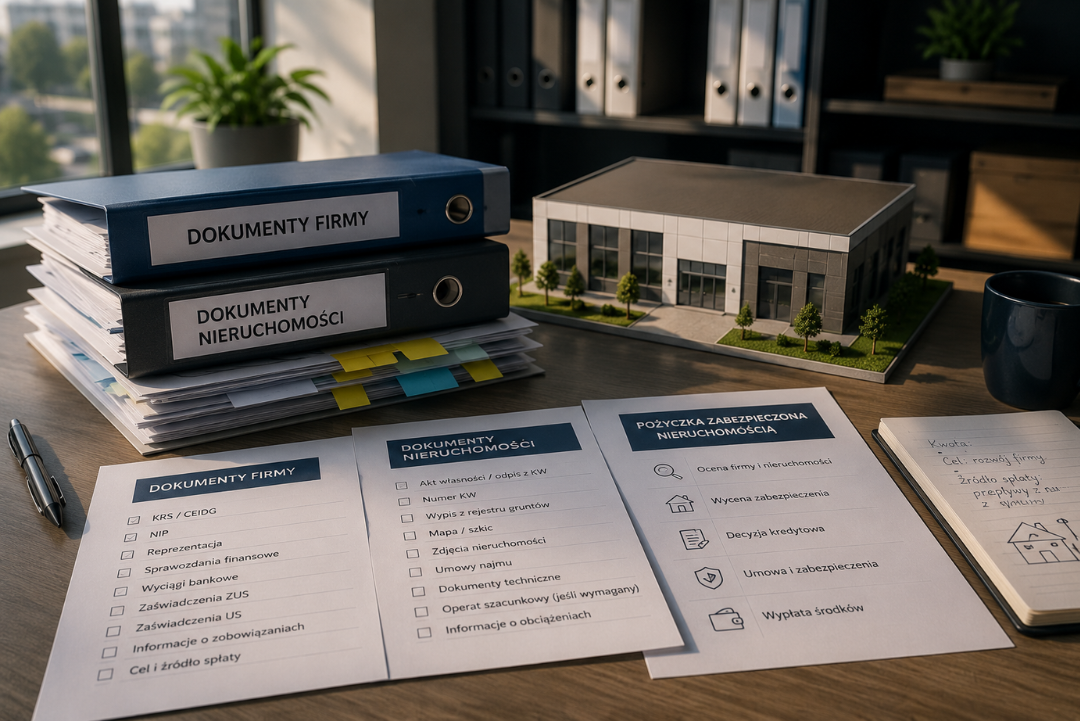
The list depends on the provider and the sole proprietor's method of taxation. There is little value in collecting random attachments before checking the requirements of a particular product. It is still possible to prepare an organised data pack.
For the PaveNow Growth Loan, we verify:
- bank statements for all business accounts from the last 6 months
- current certificates confirming no arrears in taxes and ZUS contributions
These certificates can be obtained online. See our guide to checking ZUS and tax office debt online and obtaining the information you may need.
Depending on the circumstances, a provider may also ask for:
- accounting and tax documents appropriate to the business's method of taxation
- a schedule of bank credit, loans, leases, credit limits, and guarantees
- agreements, orders, invoices, or an investment cost estimate
- an explanation of one-off inflows, refunds, or material drops in sales
- documents relating to proposed collateral
The aim is not to submit as many attachments as possible. The documents should support one consistent story: the need, the amount, the timing of the expenditure, the business's capacity to repay, and the source of the expected inflows.
How to prepare a sole proprietorship for financing step by step
Preparing for financing involves more than organising documents. You should also define the purpose, amount and source of repayment and assess how the new liability will affect the company’s liquidity. It is worth approaching the process step by step:
- Define a specific purpose. Write down what the business will purchase or finance, when the expenditure will occur and what business result it should produce.
- Calculate the amount and how long the capital will be needed. Separate the core cost from the financial buffer. Too little funding may leave the project underfunded, while too much may unnecessarily increase the cost and instalment.
- Identify the source of repayment. Base it on agreements, orders, confirmed receivables, cost savings or regular inflows rather than a general expectation of growth.
- Prepare a base-case and conservative cash flow forecast. Check what will happen if sales are lower, a customer pays late or the investment starts generating income later than expected. You can use the liquidity management tools available in CFO Suite when preparing the forecast.
- List all liabilities. Include bank credit, loans, leases, credit limits, cards, guarantees and private instalments that affect the owner’s budget.
- Verify information held by databases and public institutions. Check the business and personal BIK reports, business information registers and the company’s position with ZUS and the tax office. Resolve any discrepancies before applying. We discuss credit enquiries in more detail in Does a business financing application affect BIK?.
- Organise the documents and the explanation supporting the application. The amounts stated in the application, bank statements, accounting documents and cost estimate should be consistent. Explain unusual events instead of assuming they will not be noticed.
- Compare the total cost and contractual consequences. Review the repayment schedule, all fees, collateral, early repayment rules, consequences of late payment and the impact of instalments on the company’s cash buffer.
Can a new sole proprietorship obtain a business loan?
It depends on the product and the provider. The market includes options for businesses with a shorter history, but there is no single minimum period that applies to every institution. A shorter trading history means less data for assessing seasonality, profitability, and repayment behaviour.
The minimum operating history for the PaveNow Growth Loan is 6 months. The business must be registered in Poland, have annual turnover or a balance sheet total of at least PLN 200,000, and not be in restructuring or liquidation proceedings. Meeting these initial conditions does not guarantee financing. The decision depends on a full assessment.
If the business has not yet been established, a product designed for an operating company may not be the right route. Public start-up programmes can be an alternative, including the BGK Self-Employment Loan. Application windows are opened and closed by financing partners, so availability should be checked immediately before applying.
How to compare the cost of a business loan and assess a safe instalment
The interest rate alone is not enough to compare B2B offers. Check at least:
- the amount that will actually reach the business account
- the interest rate and how it is calculated
- the preparation fee and any other charges
- the total amount repayable
- the number, frequency, and amount of instalments
- the cost of establishing or maintaining collateral
- the early repayment rules
- the cost and consequences of late payment
Then apply the instalment to the cash flow forecast, not only to average monthly revenue.
Decision example
Assume that PLN 120,000 reaches the business account and the total amount repayable is PLN 132,000 in six equal instalments of PLN 22,000. This simplified example is designed to show how a new instalment may affect the business's cash flow.
In the base-case scenario, the business generates a monthly surplus of PLN 34,000 after operating costs and existing liabilities. PLN 12,000 remains after the new instalment. In the conservative scenario, which allows for lower sales and one late customer payment, the surplus falls to PLN 18,000. Paying the instalment then produces a PLN 4,000 shortfall.
The financing fits the base-case scenario but fails the conservative test. The business owner should consider a smaller amount, a longer schedule, a larger buffer, or postponing the investment. A safe instalment is not the highest amount the business can pay in a good month. It is an instalment that does not remove liquidity when conditions deteriorate within a realistic range.
PaveNow business loan for a sole proprietorship - terms and process
At PaveNow, we do not offer a separate product exclusively for sole proprietorships. A sole proprietorship is one of the legal forms that may apply for our Growth Loan.
We currently communicate the following terms:
- a business registered in Poland as a sole proprietorship, limited liability company, or joint-stock company
- at least 6 months in business
- annual turnover or a balance sheet total of at least PLN 200,000
- no restructuring or liquidation proceedings
- a financing amount from PLN 50,000 to PLN 1,000,000
- a repayment term from 3 to 12 months
- an interest rate from 14.5% per year
You start the process online. We analyse financial data and documents and check information held by BIK and KRD. Following the credit assessment, we present an individual offer. In selected cases, we may ask for additional financial or collateral-related documents. Once the required agreements have been signed and finalised, the funds usually reach the business account within 24 hours. Meeting the initial conditions does not guarantee financing, and the payout time depends on completion of the assessment and execution of the required documents.
Business loan for a sole proprietorship - how to make a responsible decision
Operating as a sole proprietorship does not close the door to financing, but it means the decision affects both the business and the owner. A sound application should therefore not be based solely on turnover or an urgent need for cash.
The business owner should be able to present:
- a specific purpose and amount
- the timing of the expenditure
- a credible source of repayment
- a base-case and conservative cash flow forecast
- a complete picture of liabilities
- documents consistent with the stated need
- a cost and risk level appropriate to the business's margin and buffer
A good business loan for a sole proprietorship does not begin with the maximum available amount. It begins with a calculated need, a timeline for the return of capital, and a repayment source that still works in a conservative scenario.